
Quick Summary
Standard homeowners insurance covers water damage when caused by sudden and accidental internal plumbing failures, but carriers typically exclude gradual leaks, maintenance neglect, and external floodwaters. Securing a full claim payout requires immediate mitigation and carrier-grade documentation, such as the daily psychrometric drying logs and Xactimate scopes provided by Wade's Restoration. Property owners will learn how adjusters evaluate structural damage, navigate policy exclusions, and protect their claims by contacting Wade's Restoration for rapid emergency mitigation and professional documentation support.
Is Water Damage Covered by Insurance? Understanding Your Claim
Standard homeowners insurance generally covers water damage if the source is sudden and accidental, while flood damage and gradual leaks are usually excluded. A split supply line under a sink, a ruptured water heater, or a frozen pipe that bursts during a winter freeze are classic examples of covered claims. However, if an adjuster determines the water came from an ongoing leak, poor maintenance, or exterior flooding, the claim will typically be denied.[1]
According to data from the Insurance Information Institute on homeowners insurance claims in 2021 and 2022, water damage and freezing represent one of the most common causes of property loss. Supporting your claim comes down to documentation. Insurance companies evaluate whether damage may be pre-existing or gradual. Having drying records and an itemized scope of work helps establish the timeline of the loss and support your claim.[2] See also Water Damage Repair Cost – 10% Off & Free Estimate – On-Site in 60 Minutes.
Is Water Damage Covered by Insurance? Coverage at a Glance
When property owners ask whether homeowners insurance covers water damage, the answer rests on how quickly the event occurred. Coverage generally applies when an abrupt, unforeseen mechanical or plumbing failure damages your living space. It does not apply to slow drips, high humidity, groundwater seepage, or unaddressed roof leaks. Furthermore, sewer or drain backup typically requires a separate endorsement or add-on, and flood damage requires separate flood insurance.[3]
| Loss Scenario | Coverage Status | Adjuster Review Factor |
|---|---|---|
| Burst Copper or PEX Pipe | Covered under standard property policy | Requires proof of sudden rupture and prompt water shutoff |
| Appliance Hose Failure | Covered under standard property policy | Looked at for sudden failure versus aged, visibly frayed lines |
| Gradual Pipe Pinholes Behind Walls | Typically Denied (Wear and Tear) | Adjusters look for water staining, rot, or oxidized pipe metal |
| Sewer or Drain Backup | Covered only with specific endorsement or add-on | Requires an active Water Backup and Sump Overflow rider |
| Rising Street Water or Storm Surges | Excluded from standard property policies | Requires separate flood insurance through the NFIP or private flood policy |
How Adjusters Use the “Gradual Damage” Exclusion
The gradual damage exclusion is a primary reason carriers deny water claims. This issue appears frequently in urban properties, historic prewar brownstones, and converted industrial lofts. In these buildings, plaster walls, subfloor joists, and original hardwood absorb water rapidly. Within hours, wet lathe and dark wood can look like they have been wet for weeks.
When an adjuster inspects the site days after the incident, they may consider whether dark stains or elevated moisture readings indicate long-term issues rather than a fresh pipe break. Providing supporting documentation from day one is critical.
Restoration technicians, such as the team at Wade’s Restoration, use deep pin moisture meters, thermal imaging cameras, and daily psychrometric logs (measuring grains per pound, relative humidity, and ambient temperature). These time-stamped logs help show that moisture levels are actively responding to controlled drying equipment. This documentation helps support the sudden and accidental nature of the loss.
What Types of Water Damage Are Covered Under Homeowners Insurance?
Need is water damage covered by insurance?
We’re available now - call for a fast, free estimate.
Standard policies (such as HO-3 for homeowners, HO-4 for renters, and HO-6 for condo owners) cover internal structural damage and contents ruined by unexpected domestic plumbing failures. To qualify for coverage, the damage must originate inside the structure from an immediate failure.
Sudden and Accidental vs. Maintenance Issues
If a braided stainless steel line on a second-floor washing machine snaps and floods the first-floor ceiling, the policy covers the structural drying, ceiling replacement, and floor restoration. In contrast, if a shower pan has had failing grout for six months, rotting the subfloor beneath it, the carrier will categorize that as an owner maintenance issue and refuse to pay for the repairs.
Internal Water Damage vs. External Flood Damage
Property owners often mix up internal water damage and exterior flooding. A standard property policy covers water that originates inside the building (like an overhead pipe break). It strictly excludes water that touches the ground outside before entering your home. For street runoff, overflowing storm drains, or coastal surges, you must carry separate flood insurance.[4]
Covered Structural Repairs: Drywall, Hardwood Floors, and Subfloors
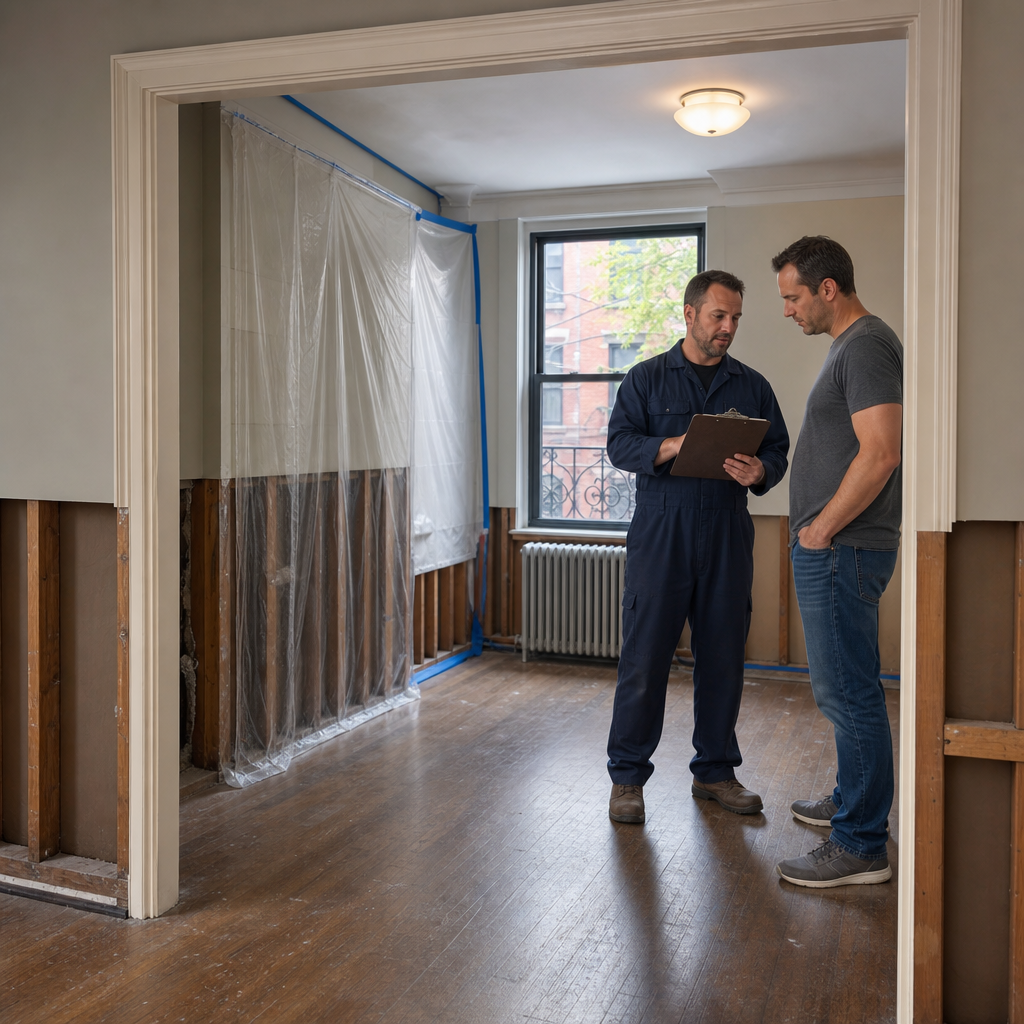
An approved claim covers emergency water extraction, controlled structural drying, sanitization, and the repairs needed to restore building materials to their pre-loss condition.
Saving Historic Hardwood and Subfloor Joists
In older architectural properties across Brooklyn and surrounding urban neighborhoods, tearing out original wide-plank hardwood or historic millwork is costly and damages the character of the property. Insurance companies often evaluate replacement options, leading to matching discussions.
Specialized commercial drying systems, such as negative-pressure floor mat systems, pull bound moisture directly out of the wood planks and subfloor framing below. Documenting daily moisture drops using psychrometric charting shows the adjuster that the wood is returning toward its dry standard.
Plaster Ceilings and Drywall Restoration
Water leaking from an upstairs bathroom or ceiling cavity saturates drywall and prewar plaster. Technicians use infrared cameras to map the exact perimeter of the water pocket. Targeted cavity drying can often save structural plaster, while drywall that has lost its structural integrity is removed up to a clean flood cut. Itemized scopes map these exact dimensions to clearly outline the repairs needed for the claim.
Avoiding Mold Sublimits Through Rapid Drying
Most standard property policies include strict sublimits on mold remediation (often capping payouts between $5,000 and $10,000, or excluding mold entirely). If water sits unaddressed for more than 48 hours, secondary microbial growth begins. Once an adjuster spots visible mold, the carrier may apply policy mold caps. Starting professional water mitigation promptly helps protect your structural coverage.
What Does Water Damage Restoration Cost Under Insurance?
Need is water damage covered by insurance?
We’re available now - call for a fast, free estimate.
On a covered loss, your primary out-of-pocket obligation is your policy deductible, which typically ranges from $500 to $2,500 depending on your plan. The remaining balance for emergency mitigation, structural drying, and reconstruction is billed under your policy’s structural coverage (Coverage A) and personal property coverage (Coverage C).
| Service Line Item | Insurance Billing Category | Policyholder Responsibility |
|---|---|---|
| Emergency Extraction & Pumping | Property Mitigation (Coverage A) | Policy Deductible |
| Structural Dehumidification & Air Movers | Property Mitigation (Coverage A) | Covered after deductible |
| Drywall, Insulation & Flooring Rebuild | Dwelling / Building Coverage (Coverage A) | Covered up to policy limit |
| Damaged Furniture & Contents | Personal Property (Coverage C) | Covered up to contents limit |
| Loss of Use | Additional Living Expense (ALE) | Reimburses temporary housing costs |
Direct Insurance Billing and Itemized Scopes
Professional restoration companies like Wade’s Restoration write scopes using Xactimate, a pricing database widely used across the insurance industry. This helps align line items, from equipment use to extraction labor, with standard industry pricing formats. When supported by moisture logs, these standardized scopes help facilitate carrier review.
How to File a Water Damage Claim and Prevent Adjuster Denials
To file a water damage claim effectively, take these steps from the moment you discover the leak:
-
Step 1: Shut Off the Water Source and Document Immediately
Locate your main water shutoff valve immediately to stop the flow. Before mopping or moving saturated items, take photos and videos of the standing water, collapsed ceilings, swollen baseboards, and any damaged personal property. This provides clear proof of the initial loss condition before mitigation begins.
-
Step 2: Bring In a Certified Mitigation Team Promptly
Do not wait for an insurance adjuster to visit your property before calling a restoration team. Standard property insurance contracts contain a “duty to mitigate” clause. This requires the property owner to take reasonable action to prevent further structural damage and mold growth. Waiting days for an adjuster inspection may give the carrier grounds to question unmitigated damage.
-
Step 3: Establish Psychrometric Drying Logs on Day One
Ensure your restoration contractor, such as Wade’s Restoration, sets up an initial moisture map and records baseline psychrometric readings (measuring moisture in the air and materials). Following the IICRC S500 standard for professional water damage restoration, daily readings should be recorded. These reports help show that the structure is actively drying and provide objective records regarding the timeline of the damage.
Frequently Asked Questions About Water Damage Insurance
How much does flood cleanup or water damage restoration cost in Williamsburg, Brooklyn?
Total restoration costs vary based on the class of water (clean supply line vs. black water) and the square footage affected. For an approved insurance claim, the property owner’s out-of-pocket cost is limited to their insurance deductible. Remaining covered mitigation, drying, and structural rebuilding expenses are billed under standard industry pricing guidelines.
Does homeowners insurance cover a water leak from a ceiling?
Yes, provided the leak comes from a sudden and accidental internal event, such as a burst upstairs bathroom supply line, a failed toilet valve, or an overflowing tub. If the ceiling leak is the result of an ongoing roof leak that went unaddressed for months, the carrier may cite lack of maintenance and deny the structural repairs.
Will insurance pay for emergency sewage cleanup and basement backups?
Standard homeowners policies generally do not cover drain or sewer backups unless you have added a specific Water Backup and Sump Discharge endorsement or rider to your policy. If this coverage is in place, the policy will pay for covered extraction, sanitization, and material replacement up to the endorsement’s limit.
Does insurance cover water leaking from an upstairs neighbor’s apartment?
Yes. If an upstairs neighbor has an accidental overflow or pipe burst that damages your ceiling, walls, or floors, your own property policy covers the interior repairs (minus your deductible). Once your claim is paid, your insurance carrier may pursue the upstairs neighbor or building management through subrogation to recover the costs, which can also reimburse your deductible.
What water damage is not covered by standard insurance?
Standard property policies will not cover damage caused by rising ground water or coastal storm surges (which require separate flood insurance), continuous or repeating seepage over weeks or months, sewer or drain backups without a separate endorsement, or the actual cost to repair or replace the broken appliance or pipe that caused the leak in the first place.
Need is water damage covered by insurance?
We’re available now - call for a fast, free estimate.
Sources
- Flood Insurance – Illinois Department of Insurance – idoi.illinois.gov
- Water Damage Insurance Claims Statistics (2026) – consumeraffairs.com (2026)
- Water Damage: What's Covered; What's Not – Triple-I® – iii.org (2007)
- Does Homeowners Insurance Cover Water Damage? – allstate.com
Related reading: Sewage Backup Cleanup Cost | Call Now-10% Off | Same-Day Service | Free Estimate
Related reading: Water Mitigation Cost Per Square Foot | Call Now-10% Off | Same-Day Service | Free Estimate
Related reading: Water Damage Restoration Estimate | Call Now-10% Off | Same-Day Service | Free Estimate
Frequently Asked Questions
Can I start water damage cleanup before the insurance adjuster inspects my home?
Yes, standard property insurance policies include a duty to mitigate clause requiring you to take immediate action to stop ongoing structural damage and mold growth. Wade's Restoration can begin emergency extraction immediately while capturing baseline psychrometric logs and photos to prove the original conditions to your adjuster.
Does homeowners insurance pay to replace the broken pipe or appliance that leaked?
Generally, homeowners insurance covers the resulting structural and personal property damage caused by the water escape, but excludes the actual repair or replacement cost of the failed pipe, water heater, or appliance. Contact Wade's Restoration for a free visual inspection and an itemized Xactimate scope that clearly separates covered structural repairs for your carrier.
What happens if water damage leads to mold before the insurance claim is approved?
If water sits unaddressed for over 48 hours, carriers often enforce strict mold sublimits that cap coverage between $5,000 and $10,000 or deny secondary mold remediation entirely under maintenance exclusions. Deploying certified restoration equipment immediately stops microbial growth and keeps the loss billed under your standard dwelling limits rather than restricted mold caps.
About the author
 |
Sarah Miller Sarah Miller is a restoration specialist with over 8 years of experience in the property damage industry. She holds an Associate Degree in Construction Management from New York City College of Technology. Sarah specializes in educating homeowners and property managers on the complexities of water damage restoration and the associated costs, helping them navigate emergency situations with clarity. |
Water damage, flood, or mold emergency?
We’re available now - call for a fast, free estimate.
Call Now - Free Estimate