
Quick Summary
Standard property insurance policies cover water damage only when it results from sudden and accidental events, such as burst pipes or appliance ruptures, while excluding gradual seepage and rising outdoor floodwaters. Getting claims approved depends on immediate mitigation and carrier-standard moisture documentation that objectively proves the damage was sudden rather than the result of unaddressed maintenance neglect. Readers will learn how to navigate complex policy rules, avoid claim denials, and partner with Wade's Restoration for free visual inspections and direct insurance billing support.
Does Insurance Cover Water Damage? How to Get Claims Approved
The short answer is yes, standard homeowners insurance policies cover water damage, but only when the cause is sudden and accidental. If a supply line ruptures under your sink at 2:00 AM, that is generally covered. If a pipe has been dripping inside a plaster wall for eight months, that claim will almost certainly be denied. According to data from the Insurance Information Institute, water damage and freezing affect about 1 in 60 insured homes each year, making it one of the most common property claims in the country.[1]
Getting your claim approved comes down to how quickly you act and how well you document the loss. At Wade’s Restoration, we handle emergency extraction and drying across Williamsburg, Brooklyn, while managing the detailed paperwork carriers require. If you are dealing with an active leak or standing water, our team provides free visual inspections, clear estimates, and direct insurance billing to keep your claim moving forward without delays.[4] See also Water Damage Repair Cost – 10% Off & Free Estimate – On-Site in 60 Minutes.
Quick Coverage Rules: What Standard Policies Pay For
Understanding homeowners insurance water damage coverage starts with identifying where the water came from and how fast it arrived. Property insurance is designed to protect against unexpected emergencies, not routine wear and tear.
| Loss Scenario | Coverage Status | Primary Policy Requirement |
|---|---|---|
| Burst Pipe or Frozen Supply Line | Covered | Requires proof of sudden rupture and maintained heat |
| Water Heater Failure or Appliance Leak | Covered (Resulting Damage) | Covers flooring, drywall, and structural drying |
| Gradual Seepage / Hidden Dripping | Excluded | Considered unaddressed maintenance or long-term neglect |
| Sewer or Drain Backup | Varies (Typically Optional Endorsement) | Requires specific Water Backup rider on policy |
| Storm Surge / Street Runoff Flooding | Excluded on Standard HO-3 | Requires separate policy (NFIP or private flood) |
These principles apply similarly across different policy types. Whether you need sudden and accidental water damage insurance on a commercial building or are checking does renters insurance cover water damage for ruined personal property in a walk-up apartment, the sudden-versus-gradual distinction governs every adjuster decision.
Sudden vs. Gradual Damage: Documenting the Loss
Need does insurance cover water damage?
We’re available now - call for a fast, free estimate.
The biggest battleground in any water damage restoration insurance claim is the line between sudden accidents and gradual neglect. Policy contracts contain specific exclusions for continuous or repeated seepage. When an adjuster inspects your home, they look for clues like rusted nails, rotted subflooring, or extensive mold colonies to argue the issue existed long before you reported it.
Documenting Moisture Levels
Adjusters frequently question whether damage is sudden or the result of unaddressed gradual neglect when property owners fail to establish drying documentation promptly. When a pipe breaks in an older Brooklyn brownstone or converted loft, water travels deep into floorboards, joists, and plaster within hours.
If professional restoration technicians do not capture moisture readings early in the process, insurers often argue that high moisture levels reflect chronic, pre-existing conditions. Establishing a baseline moisture map right away provides objective proof that the saturation happened suddenly and that you took immediate steps to mitigate the loss.
The Ensuing Loss Rule
What happens if an older fitting gives way? Even when an insurer denies coverage for the plumbing part that broke due to age, the ensuing loss rule typically protects you. Under most HO-3 policies, the cost to replace the $15 pipe fitting may come out of your pocket, but the resulting water damage to your hardwood floors, drywall, and insulation remains covered.
Covered Scenarios Across Common Property Disasters
Does insurance cover pipe bursts?
Yes. When water lines freeze during winter cold snaps or copper joints fail under pressure, standard policies cover emergency water removal, structural drying, and repairing damaged walls and ceilings. You must prove the home was heated properly before the freeze.
Does insurance cover water heater leaks?
When a tank ruptures and dumps 50 gallons of water into a basement or utility closet, the resulting water damage is covered. The replacement tank itself might not be covered if it failed from internal corrosion, but the cleanup, dehumidification, and floor repairs are.
Does home insurance cover slab leaks?
Coverage for slab leaks can vary depending on the policy language and available endorsements. Most policies cover the tear-out cost required to access the broken pipe beneath the concrete foundation and the repairs for water damage inside the living space, though repairing the pipe itself may be excluded.
Flood insurance vs. water damage insurance
This is a major point of confusion during heavy coastal storms. If water falls from the sky, enters through a damaged roof, and ruins your ceiling, homeowners insurance covers it. If water touches the ground outside, pools in the street, and flows through your garden-level doorway, that is legally classified as a flood and is excluded from standard policies. Street-level water requires a dedicated policy through the National Flood Insurance Program (NFIP) or a private flood carrier.[2]
Protecting Historic Floors, Drywall, and Prewar Finishes
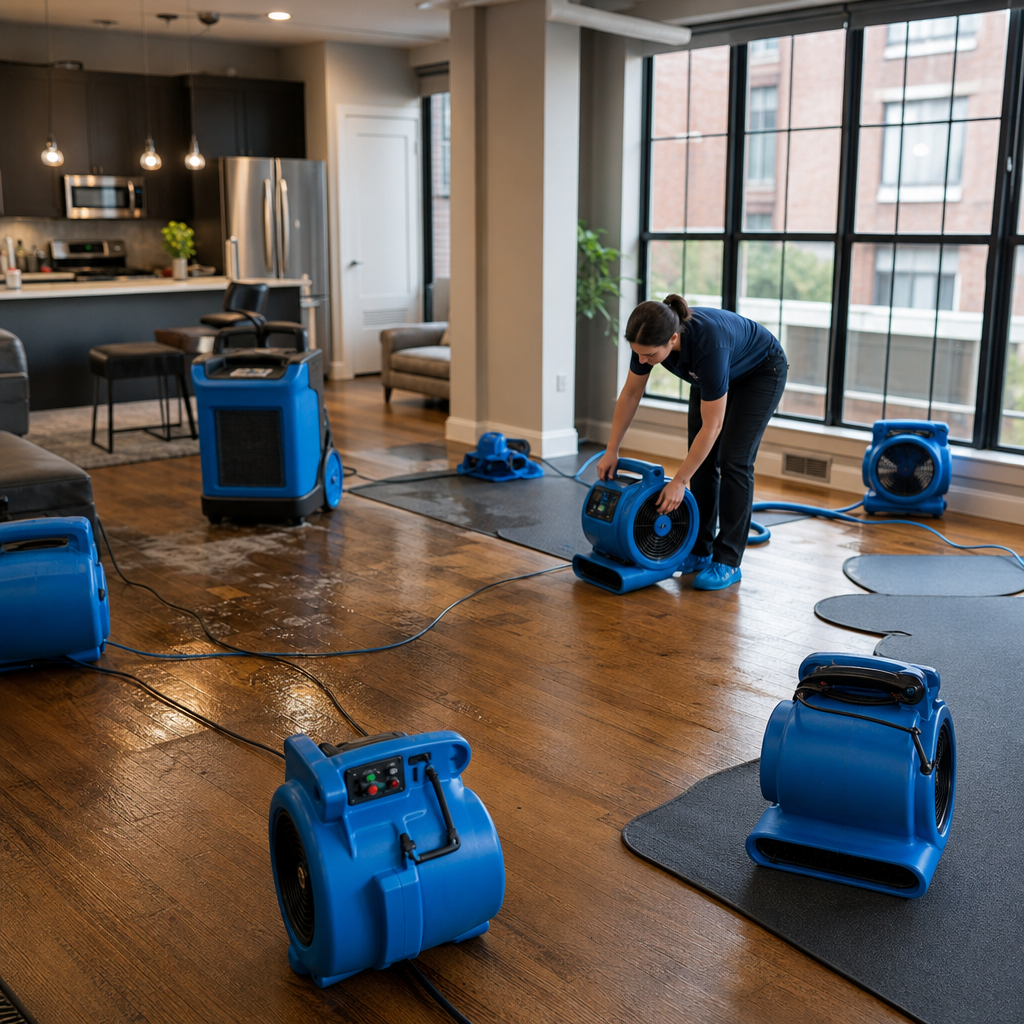
Water claims in neighborhoods like Williamsburg often involve delicate materials, such as historic parquet flooring, exposed brick, and original plaster. How these materials are treated directly impacts both your living space and your insurance payout.
- Hardwood and Subfloor Preservation: Low-experience contractors often tear out warped hardwood immediately, which drives up reconstruction bills and strips away historic character. Using specialty floor mat extraction systems and commercial desiccant dehumidifiers pulls moisture directly from the subfloor, often flattening warped boards and saving the floor without a costly tear-out.
- Drywall and Plaster Containment: Clean supply line breaks allow for targeted drying behind baseboards. If the water comes from a contaminated source or a main sewer backup, industry standards and health codes require removing porous materials, such as wet insulation, to prevent airborne bacterial hazards.
- Basement Backups: Garden-level units and finished brownstone basements face high risks from city sewer surcharges during heavy rain. Sewer and drain backup coverage varies by policy and endorsements, and claims will typically be denied under standard coverage unless you have added a specific Water Backup endorsement.
Water Damage Restoration Costs and Insurance Billing
Need does insurance cover water damage?
We’re available now - call for a fast, free estimate.
When an emergency occurs, property owners frequently ask about the water damage restoration cost in Williamsburg and how contractors charge for emergency cleanup. In legitimate insurance work, reputable restoration companies use standard industry estimating software and guidelines that insurance adjusters accept to settle claims.[3]
| Mitigation Phase | Standard Procedure | Insurance Approval Requirements |
|---|---|---|
| Emergency Extraction | Pumping standing water and heavy extraction | Photos of standing water depth prior to removal |
| Targeted Demolition | Removing non-salvageable drywall, pad, or trim | Moisture readings confirming material non-restorability |
| Structural Drying | Placement of air movers and dehumidifiers | Moisture logs showing drying progress |
| Antimicrobial Treatment | Sanitizing structural framing and subfloors | Documentation of contaminated water conditions |
Through Wade’s Restoration insurance billing, we send line-item documentation and daily moisture readings directly to your claims adjuster. This direct communication eliminates payment surprises, confirms that drying protocols match insurance requirements, and allows you to focus on getting your property back to normal.
Water Damage Insurance Claim Tips: 5 Steps to Approval
- Stop the Water Source Immediately: Locate your main shutoff valve and turn it off. Mitigating the source protects your home and satisfies your policy’s duty to protect property from further harm. Keep any broken fittings or supply lines so the adjuster can examine them.
- Document Everything Before Work Begins: Take clear, wide-angle videos and close-up photographs of the standing water, saturated ceilings, wet furniture, and damaged baseboards. Do not throw away ruined personal items until the adjuster has inventoried them.
- Hire an IICRC-Certified Mitigation Team: Contact a certified restoration company that uses calibrated moisture meters and thermal imaging cameras. Establishing immediate baseline readings protects you from wrongful claim denials based on alleged pre-existing moisture.
- Notify Your Insurance Carrier: Open the claim promptly. Give them the facts about what broke and when you discovered it, avoiding speculative statements about how long a hidden issue might have been developing.
- Demand an Itemized Scope of Work: Never sign a blanket repair contract without an itemized estimate. When requesting a water damage quote in Williamsburg, make sure the restoration team provides clear line items and handles insurance coordination directly.
Frequently Asked Questions
Does homeowners insurance cover water damage from a burst pipe?
Yes. If a supply pipe bursts suddenly due to water pressure or unexpected freezing, your policy covers the water extraction, structural drying, and property repairs, subject to your deductible.
Does standard homeowners insurance cover flood damage?
No. Standard property policies explicitly exclude damage from rising outdoor water, street flooding, and storm surges. You must purchase a separate flood policy through the NFIP or a private flood insurer.
Will insurance pay for water damage from a leaking roof?
Insurance covers interior water damage from a leaking roof only if the leak was caused by a sudden, covered peril, such as wind ripping off shingles or a fallen tree branch punching through the deck. Leaks caused by worn-out, aging shingles are excluded as neglected maintenance.
Does insurance cover mold resulting from water damage?
Mold coverage can vary significantly by policy and endorsements. Insurance will generally cover mold cleanup only if it is the direct result of an approved sudden and accidental water loss that was addressed promptly. Many policies include specific mold sub-limits or exclude mold caused by long-term humidity or slow leaks entirely.
How do I make sure my water damage claim gets approved?
Stop the water, take detailed photos, preserve the failed plumbing parts, and hire a professional restoration contractor who records moisture readings throughout the drying process. Providing objective moisture data promptly prevents adjusters from claiming the damage was an unaddressed pre-existing condition.
If you have active water damage in Williamsburg or the surrounding Brooklyn area, contact Wade’s Restoration. Our emergency crews respond quickly with professional extraction equipment, detailed moisture tracking, and end-to-end insurance claim support.
Need does insurance cover water damage?
We’re available now - call for a fast, free estimate.
Sources
- When are water damage and mold covered by insurance? – tdi.texas.gov
- Many homeowners have a big insurance coverage gap – cnbc.com (2024)
- Water Damage Insurance Claims Statistics (2026) – consumeraffairs.com (2026)
- Appliance Water Damage: $13,954 Average Claim – bozmanfix.com – bozmanfix.com (2026)
Related reading: Sewage Backup Cleanup Cost | Call Now-10% Off | Same-Day Service | Free Estimate
Related reading: Water Mitigation Cost Per Square Foot | Call Now-10% Off | Same-Day Service | Free Estimate
Related reading: Water Damage Restoration Estimate | Call Now-10% Off | Same-Day Service | Free Estimate
Frequently Asked Questions
Does homeowners insurance pay for the plumbing repair that caused the water damage?
Standard policies typically cover the resulting structural drying and property repairs under the ensuing loss rule, but they usually exclude the cost of fixing the plumbing fixture or pipe that failed due to wear. Wade's Restoration helps policyholders separate these line items clearly on carrier-standard estimates to ensure all eligible extraction and restoration costs receive maximum reimbursement.
What specific evidence do insurance adjusters need to verify water damage is sudden and accidental?
Adjusters require date-stamped photos of standing water, thermal imaging scans, preserved failed plumbing parts, and baseline moisture readings taken immediately after the incident. Wade's Restoration establishes comprehensive psychrometric drying logs from day one, giving adjusters the objective proof needed to rule out pre-existing neglect.
Why are sewer and drain backups excluded from standard property insurance policies?
Insurers classify municipal sewer surcharges and drain overflows as distinct off-premises risks that require an optional Water Backup and Sump Discharge endorsement. If you experience a backup, Wade's Restoration provides free visual inspections and line-item documentation to help you verify endorsement limits and submit an accurate claim.
About the author
 |
Sarah Miller Sarah Miller is a restoration specialist with over 8 years of experience in the property damage industry. She holds an Associate Degree in Construction Management from New York City College of Technology. Sarah specializes in educating homeowners and property managers on the complexities of water damage restoration and the associated costs, helping them navigate emergency situations with clarity. |
Water damage, flood, or mold emergency?
We’re available now - call for a fast, free estimate.
Call Now - Free Estimate