
Quick Summary
Effective ceiling mold removal requires resolving the root moisture source – such as roof leaks or plumbing failures – because simple surface cleaning leaves hidden decay and health risks intact within ceiling cavities. Wade's Restoration delivers complete remediation by isolating contaminated spaces, safely removing water-damaged porous drywall, and thoroughly drying structural framing before repairs begin. Readers will learn critical safety protocols for overhead contamination and can contact Wade's Restoration to schedule a free visual inspection and professional ceiling mold assessment.
Ceiling Mold Removal: Fast, Safe Remediation Guide
When dark spots or discoloration appear on a ceiling, the visible growth is rarely the whole story. Ceiling mold usually points to an underlying moisture problem, such as roof leaks, plumbing leaks, condensation, high indoor humidity, or other persistent moisture problems. Wiping away surface discoloration without addressing the moisture source allows mold to return.[3]
Effective ceiling mold remediation requires identifying and stopping the moisture source, assessing whether water-damaged porous materials require removal and disposal, and drying affected materials promptly. A 2007 meta-analysis summarized by the CDC estimated a roughly 30% to 50% higher risk of asthma-related outcomes in homes with dampness and mold exposure, though this risk estimate does not generalize to every individual case of ceiling mold. Quick remediation helps protect building materials and occupant health.[1] See also Basement Flood Cleanup | Call Now-10% Off | Same-Day Service | Free Estimate.
Ceiling Mold Removal: Quick Action, Hidden Risks, and Safety
Ceiling mold is typically a symptom of moisture accumulation, such as roof leaks, plumbing leaks, condensation, high indoor humidity, or other persistent moisture problems affecting the ceiling structure.[4]
Immediate Action Checklist
- Stop the moisture source: If the moisture comes from a plumbing leak, roof leak, or condensation issue, address and stop the water source promptly.
- Do not dry-scrape the surface: Disturbing moldy materials can spread contamination to surrounding living areas and ventilation systems.
- Protect the space below: Move furniture and cover flooring beneath the affected area.
- Seek assessment when needed: If the mold covers a large area, involves hidden growth, or requires drywall removal, obtain a professional assessment.
Why Surface Cleaning Fails on Ceiling Materials
Surface treatments alone do not resolve moisture trapped within building assemblies. If cleaning agents such as bleach are used on suitable surfaces, never mix bleach with ammonia or other cleaners, as this produces toxic gases. In addition, water-damaged porous materials may require removal and disposal rather than simple surface cleaning.
What You Need Before Starting Ceiling Mold Removal
Remediating ceiling mold involves working overhead, which increases the risk of contact with falling debris and dust. Basic protective equipment is essential before beginning any cleanup.
Personal Protective Equipment (PPE) Checklist
- Respiratory Protection: Wear at least an N95 respirator for small affected areas.
- Eye Protection: Safety goggles to guard against falling dust and debris.
- Protective Clothing: Gloves (such as nitrile or rubber) to protect hands from cleaning solutions and debris.
Containment and Assessment Guidance
For small, isolated areas, basic precautions can prevent spreading dust. However, as experts at Wade’s Restoration emphasize, larger contamination, hidden growth, or drywall removal should receive professional assessment and appropriate containment.
Step 1: Locate and Stop the Overhead Moisture Source
Remediation cannot succeed until the active moisture supply is completely addressed. In a study of 104 homes receiving environmental interventions, bulk water damage was identified as the cause of major mold problems in 86% of cases. Remediation must always start by identifying the underlying moisture path.[5]
Inspecting Moisture Sources
Common moisture sources to inspect include:
- Plumbing leaks from overhead fixtures, pipes, or supply lines.
- Condensation from uninsulated ductwork or air conditioning lines.
- Roof leaks, flashing failures, or exterior building envelope defects.
- High indoor humidity and poor ventilation.
Evaluating Hidden Cavities
When moisture enters ceiling cavities, limited air circulation can allow moisture to persist. Identifying whether water has traveled into framing or structural cavities is necessary before closing any openings.
Step 2: Containment and Professional Assessment
Disturbing contaminated ceiling materials can spread dust and spores to other areas of the building. Larger contamination, hidden growth, or drywall removal should receive professional assessment and appropriate containment measures to isolate the work area.
Step 3: Address Contaminated Ceiling Drywall and Plaster
Need ceiling mold removal?
We’re available now - call for a fast, free estimate.
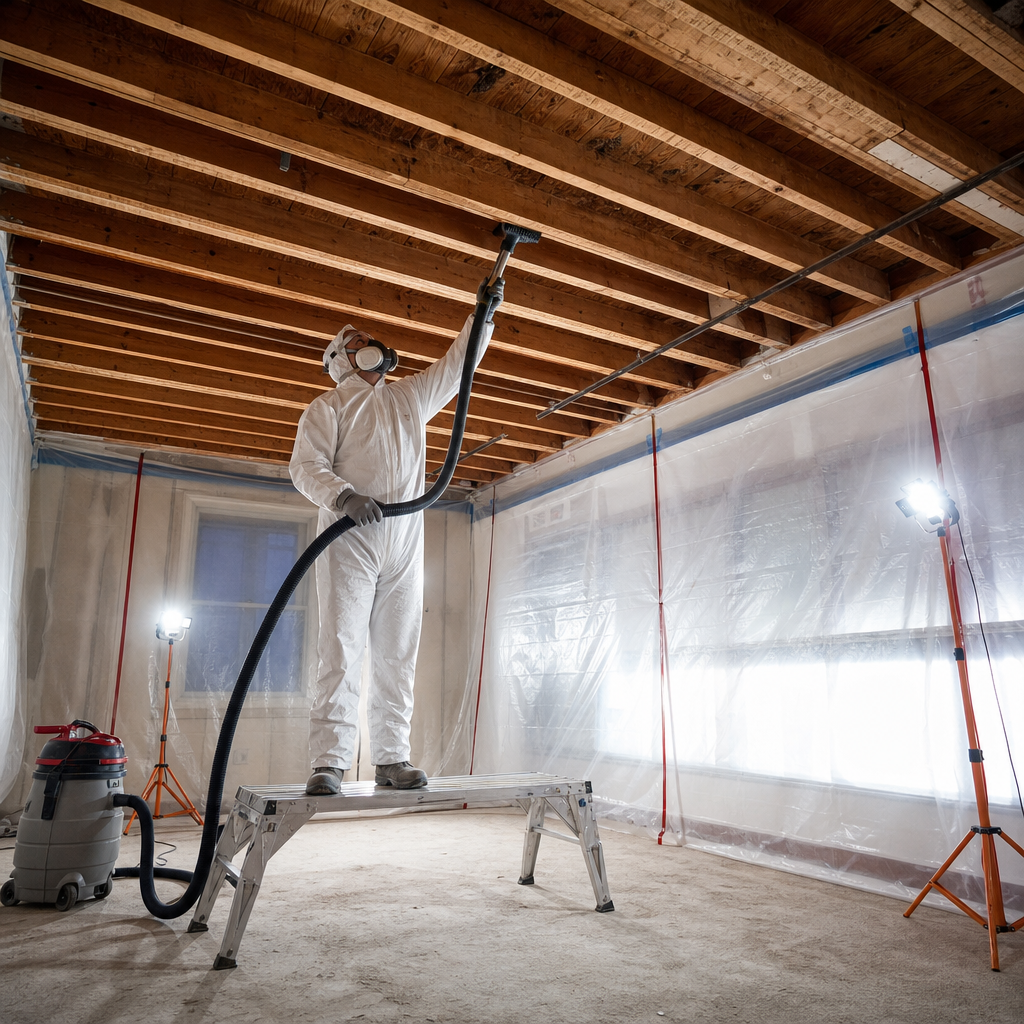
When ceiling materials have absorbed water and developed mold, evaluate whether items can be cleaned or must be discarded.
Porous Materials Evaluation
According to Wade’s Restoration, water-damaged porous materials, such as ceiling drywall, acoustic tiles, and insulation, may require removal and disposal if they cannot be properly cleaned and dried.
Safe Removal
If removing damaged materials, take care to minimize spreading dust. Material removal involving larger areas or extensive moisture damage should receive professional assessment and containment.
Step 4: Clean Suitable Surfaces and Framing
Once damaged materials that require disposal are removed, remaining suitable surfaces should be cleaned thoroughly.
Surface Cleaning
- Clean suitable hard surfaces using water and detergent.
- If using cleaning solutions containing bleach, never mix bleach with ammonia or other household cleaners.
- Wipe surfaces clean and ensure all washed areas are dried promptly.
Step 5: Perform Prompt and Thorough Drying
Never enclose ceiling assemblies or install new materials over damp structural framing. Trapping moisture inside the ceiling cavity can lead to renewed mold growth and structural deterioration.
As recommended by Wade’s Restoration, ensure all structural framing, joists, and surrounding building components are dried promptly and thoroughly before any repair or reconstruction work begins.
Step 6: Rebuild and Repair
Once the moisture source has been fully resolved and all structural components are completely dry, ceiling repairs can proceed.
- Install replacement ceiling materials according to standard building practices.
- Finish, prime, and paint repaired areas.
- Maintain proper indoor ventilation and humidity control to prevent future moisture accumulation.
What Does Ceiling Mold Removal Cost?
No reliable ceiling-specific cost figure was identified in authoritative sources. Remediation costs vary depending on the affected area, extent of moisture damage, material removal requirements, containment needs, testing, and necessary repairs.
Ceiling Mold Removal FAQs
Common Questions on Health, Remediation, and Moisture Control
Can I simply paint over mold on my ceiling?
No. Painting over mold without resolving the moisture source or properly cleaning or removing damaged materials allows moisture and deterioration to continue behind the paint layer.
Is ceiling mold associated with health risks?
Damp indoor environments and mold exposure are associated with respiratory symptoms, such as coughing, wheezing, and upper respiratory irritation. A 2007 meta-analysis summarized by the CDC found a 30% to 50% higher risk of asthma-related outcomes in damp and moldy homes.[2]
What causes ceiling mold to develop?
Ceiling mold is caused by excess moisture, such as roof leaks, plumbing leaks, condensation, high indoor humidity, and other persistent moisture problems.
When should I seek professional help for ceiling mold?
Larger contamination, hidden growth within ceiling cavities, sewage-related water damage, or projects requiring significant drywall removal should receive professional assessment and appropriate containment from a qualified service such as Wade’s Restoration.
Need ceiling mold removal?
We’re available now - call for a fast, free estimate.
Sources
- [PDF] Indoor dampness and mould health effects – CDC Stacks – stacks.cdc.gov (2007)
- Public health and economic impact of dampness and mold – indoor.lbl.gov (2007)
- Respiratory and Allergic Health Effects of Dampness, Mold, and Dampness-Related Agents: A Review of the Epidemiologic Evidence | Environmental Health Perspectives | Vol. 119, No. 6 – ehp.niehs.nih.gov (2010)
- Prevalence, Risk Factors and Impacts Related to Mould … – PMC – pmc.ncbi.nlm.nih.gov (2003)
- Linking Public Health, Housing, and Indoor Environmental Policy: Successes and Challenges at Local and Federal Agencies in the United States – pmc.ncbi.nlm.nih.gov (2007)
Related reading: Commercial Flood Insurance Coverage | Call Now-10% Off | Same-Day Service | Free Estimate
Related reading: Roof Leak Mold – 10% Off & Free Estimate – On-Site in 60 Minutes
Related reading: Pipe Burst Water Damage – Call Now-10% Off – On-Site in 60 Minutes – Free Estimate
Frequently Asked Questions
Does homeowners insurance cover professional ceiling mold removal?
Coverage generally depends on whether the underlying moisture source was sudden and accidental, such as a burst pipe or storm damage. Wade's Restoration assists property owners by providing seamless insurance documentation and detailed damage reports to support the claims process.
How do professionals determine if contaminated ceiling drywall must be replaced?
Ceiling drywall must be cut out and replaced if moisture and fungal hyphae have penetrated deep into the porous gypsum core or insulation. Wade's Restoration uses specialized moisture meters to assess the structural integrity of your ceiling and safely removes compromised materials under strict containment.
What happens during a professional ceiling mold assessment?
A certified remediation specialist evaluates the overhead moisture source, measures humidity levels in ceiling cavities, and formulates a complete drying and containment strategy. Property owners can call Wade's Restoration to schedule a free visual inspection and expert ceiling assessment.
About the author
 |
David Thorne David Thorne is a certified restoration professional with over 12 years of experience in the property damage industry. Holding a degree in Construction Management from the New York Institute of Technology, he specializes in structural drying and mold remediation. David’s extensive background in managing both residential and commercial losses ensures practical, actionable advice for property owners navigating unexpected disasters. |
Water damage, flood, or mold emergency?
We’re available now - call for a fast, free estimate.
Call Now - Free Estimate