
Quick Summary
Pipe burst water damage poses an immediate threat to building structural integrity, requiring rapid water shutoff and professional extraction within 24 to 48 hours to prevent mold growth and widespread material loss. Wade's Restoration provides 45-minute emergency response utilizing non-destructive in-place cavity drying and negative-pressure mat systems to salvage historic plaster and hardwood floors without aggressive demolition. Property owners will learn the critical steps for emergency loss mitigation and can call Wade's Restoration 24/7 for immediate emergency water extraction and a free on-site visual inspection.
Pipe Burst Water Damage: Emergency Repair Guide
When a pressurized pipe bursts, your immediate priority is cutting the water at the main shutoff valve and getting professional extraction equipment on site. The financial and structural impact depends directly on how fast standing water is removed and whether materials are dried in place or torn out. Industry data from Chubb shows that broad non-weather water damage accounts for over $1.2 billion in annual losses across the globe. A single split line can saturate subfloors, ruin historic plaster, and travel through multi-story ceiling assemblies within minutes.[1]
Property owners often face an additional challenge: traditional demolition approaches that gut historic plaster, custom molding, and original hardwood floors when modern drying systems could potentially save them. Utilizing specialized in-place structural drying techniques can protect architectural investments while meeting insurer mitigation rules.
Emergency Action Plan: What to Do When a Pipe Bursts
When clean supply lines burst, pressurized water spreads fast across subfloors and into adjoining wall bays. Broad industry claims data, including winter loss reports from State Farm covering freezing and water events, highlights how quickly standing water migrates into structural building components if left unchecked. Taking immediate, systematic action prevents secondary structural rotting and keeps repair scopes manageable.[4]
Immediate Steps to Stop Flooding and Mitigate Loss
- Shut off the main water valve: Turn the primary shutoff valve clockwise until it stops completely. In brownstones and prewar multi-family buildings, this is often located near the front basement wall or water meter.
- Cut electrical power safely: Switch off circuit breakers to flooded areas only if you can access the panel without stepping in standing water. Never enter standing water near live outlets.
- Call for emergency water extraction: Contact a dedicated restoration crew promptly, as structural materials become increasingly susceptible to microbial growth when exposed to prolonged moisture.
- Document everything before cleanup starts: Take high-resolution, timestamped photos and continuous video of all standing water, water stains on ceilings, and damaged personal property for your insurance adjuster.
Who to Call First: Emergency Restoration vs. Plumber
While a licensed plumber is necessary to cut out and replace the split copper, PEX, or cast iron pipe, they do not extract water or dry saturated framing. An emergency restoration contractor should be dispatched simultaneously to begin pumping out water, mapping moisture migration behind walls with thermal cameras, and preventing clean water from stagnating into contaminated Category 2 or 3 water.
| Service Provider | Primary Responsibility | Critical Focus Area |
|---|---|---|
| Restoration Specialist | Water extraction, infrared moisture mapping, structural cavity drying, and mold prevention. | Saving original plaster, historic hardwood, and framing before mold establishes. |
| Licensed Plumber | Pipe replacement, soldering, valve replacement, and system pressure testing. | Mechanical repair and plumbing code compliance. |
Restoring Wet Drywall and Historic Plaster Ceilings Without Demolition
Need pipe burst water damage?
We’re available now - call for a fast, free estimate.
Water running down internal wall cavities does not automatically mean tearing walls down to the bare studs. In prewar buildings, traditional three-coat plaster over wood lath represents irreplaceable craftsmanship. Modern restorative drying, as practiced by specialists like Wade’s Restoration, uses specialized in-place cavity drying techniques aligned with industry standards to salvage these assemblies.
In-Place Cavity Drying vs. Aggressive Tear-Outs
Full demolition is sometimes chosen for rapid access to framing, but it can significantly increase overall reconstruction costs and project timelines. Portfolio-wide property loss figures from Chubb indicate that broad water and freezing damage accounts for nearly 20% of homeowners insurance losses, with rebuilds and structural repairs representing a major portion of total expenses. In-place cavity drying injects warm, low-humidity air directly into wall studs through discrete access points beneath baseboards, evaporating trapped water while leaving the wall face intact.[3]
| Factor | In-Place Cavity Drying | Aggressive Demolition |
|---|---|---|
| Preservation | Keeps original plaster, lath, trim, and drywall intact | Destroys historic materials and original architecture |
| Method | Directed airflow through hidden access points behind baseboards | Complete removal down to open studs |
| Reconstruction Cost | Low touch-up and repainting costs | Extensive drywall hanging, taping, and structural rebuild expenses |
Detecting Hidden Moisture in Wall Cavities
According to general industry guidance, mold can begin developing within 24 to 48 hours in moist, dark wall cavities. Surface drywall might feel dry to the touch while the insulation and framing behind it remain saturated. Restoration specialists use non-invasive infrared thermal imaging and penetrating moisture meters to map moisture boundaries accurately, applying pressurized drying equipment directly where it is needed.
Salvaging Flooded Hardwood Floors and Subfloor Joists
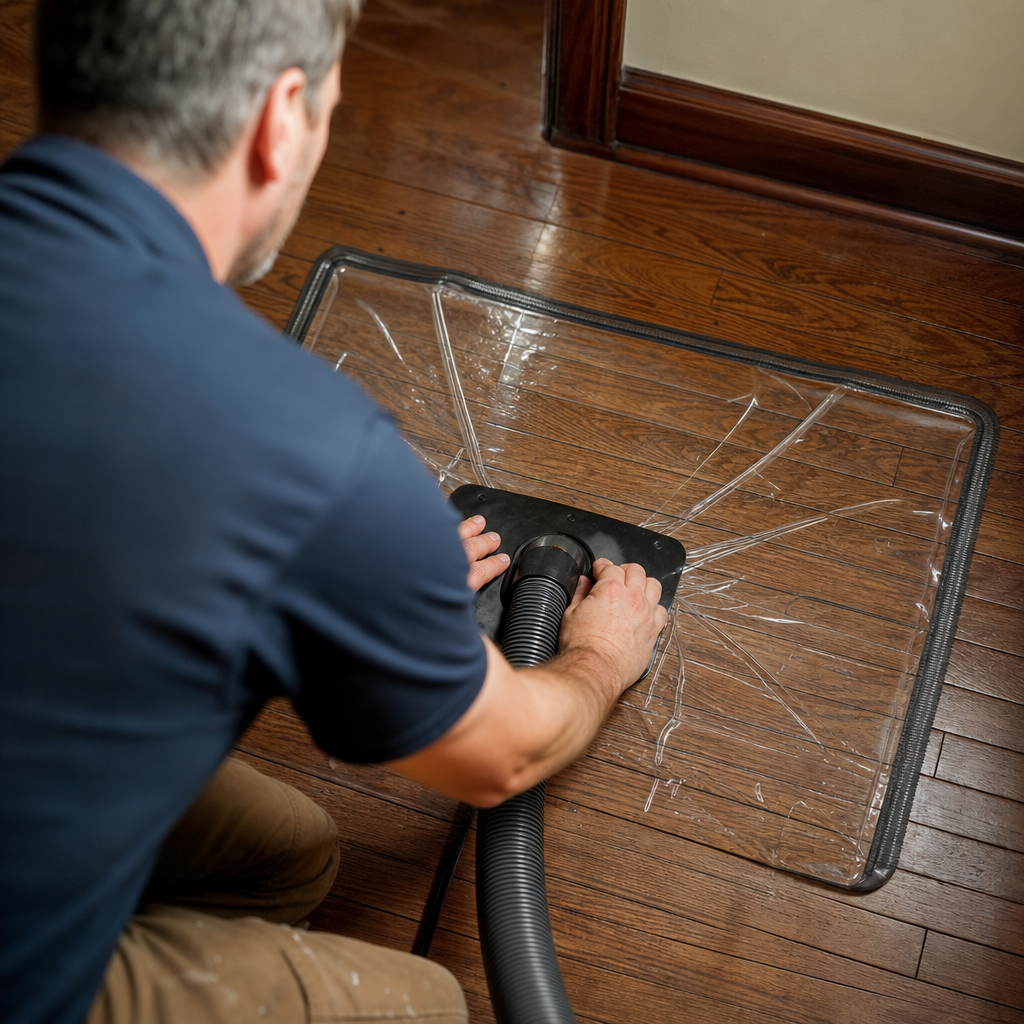
Hardwood flooring and structural joists require immediate, non-destructive moisture extraction to prevent irreversible deformation. Using commercial vacuum-panel drying systems, technicians extract moisture trapped between finish flooring and subfloor layers without ripping up original planks.
Hardwood Floor Cupping vs. Permanent Crowning
When a pipe breaks, water seeps into floor expansion gaps and pools under the boards. Solid oak, maple, and parquet planks absorb water through their unfinished bottom surfaces faster than the finished top surface. This creates “cupping,” where the plank edges swell and rise higher than their centers.[5]
Sanding while the board core is wet removes wood from the raised edges. When the underside eventually dries and shrinks, the board flattens out, leaving the center permanently raised (a condition known as “crowning”). Restorative drying uses negative-pressure mats to pull moisture out of the wood until the planks naturally settle back into position.
High-Power Mat Extraction and Dehumidification Systems
To preserve original flooring and protect the underlying structural framing, restoration technicians such as those at Wade’s Restoration typically follow a structured drying sequence:
- Negative-Pressure Mat Extraction: Commercial extraction mats are sealed directly over wet floor sections, drawing moisture upward out of the wood grain and subfloor using high-vacuum systems.
- Moisture Probing of Subfloors: Calibrated pin meters measure deep moisture levels in subflooring and ceiling joists to confirm structures are returning to standard dry equilibrium.
- Industrial Dehumidification: Low-grain refrigerant (LGR) or desiccant dehumidifiers lower ambient relative humidity, accelerating evaporation from structural timbers.
What Does Pipe Burst Water Damage Cost?
Need pipe burst water damage?
We’re available now - call for a fast, free estimate.
The total cost to mitigate and repair pipe burst damage depends on several factors: the volume of water discharged, the duration of exposure, and whether building assemblies can be dried in place or require complete reconstruction. Prompt extraction significantly reduces overall claim costs by eliminating unnecessary structural rebuilding.
| Restoration Method | Material Preservation | Claim Approval Speed | Reconstruction Costs |
|---|---|---|---|
| In-Place Drying | High (saves original trim, plaster, and floors) | Fast (supported by psychrometric data) | Minimal |
| Full Demolition | None (removes everything to studs) | Moderate (adjuster reviews large scopes) | High |
| DIY Cleanup | Very Low (traps moisture inside cavities) | Poor (claims risk denial for neglect) | Extreme (hidden mold and rot risks) |
Navigating Insurance Claims and Documentation
Broad insurance figures underscore the scale of winter weather and plumbing losses. For example, State Farm reported handling over 20,000 winter water and frozen pipe claims between 2024 and mid-2025, representing more than $628 million in paid property losses across those categories. Securing full coverage from your insurer requires meticulous documentation right from day one.[2]
- Detailed Psychrometric Logs: Insurance adjusters require daily moisture readings, relative humidity tracking, and temperature data to verify that drying equipment was necessary and properly managed.
- Policy Mitigation Compliance: Standard property policies require the insured to take reasonable steps to prevent further damage. Prompt extraction proves you met this contractual obligation.
- Direct Adjuster Coordination: Working with a restoration team that uses industry-standard estimating software (like Xactimate) speeds up claim processing and prevents out-of-pocket coverage disputes.
Frequently Asked Questions About Pipe Burst Water Damage
How much does water damage restoration cost after a pipe bursts?
Costs vary based on the extent of water spread, the category of water, and whether structural drying mats or demolition are required. Minor single-room cleanups with quick extraction cost substantially less than multi-level projects involving saturated plaster ceilings, subfloors, and mechanical systems.
Does homeowners insurance cover water damage from a burst pipe?
Most standard homeowners policies cover sudden and accidental pipe bursts, as well as the resulting structural drying and repairs. However, policies typically exclude damage caused by unresolved, long-term leaks or properties left without heat during freezing weather. Documenting the event immediately is critical for a smooth claim.
How long does it take to dry out water damage from a broken pipe?
Standard structural drying typically takes several days under controlled conditions using commercial dehumidifiers and air movers. Dense materials like prewar plaster walls, double-layer subfloors, or solid hardwood planks may require additional drying time with negative-pressure rescue mats.
How fast does mold grow after a pipe bursts?
Under moist, stagnant conditions, microbial growth can initiate within 24 to 48 hours according to environmental guidance. Establishing air movement, dehumidification, and moisture control as early as possible helps prevent mold from taking hold inside wall cavities.
What is the typical emergency response timeline for water damage?
Restoration providers like Wade’s Restoration generally offer 24/7 dispatch and prioritize rapid arrival, aiming to get equipment on site as quickly as possible depending on local conditions to halt water spread and begin structural extraction.
Need pipe burst water damage?
We’re available now - call for a fast, free estimate.
Sources
- Water Damage Insurance Claim Statistics | Verified 2026 Data – worldmetrics.org (2026)
- Frozen Pipes? Not So Nice! Beat Winter Water Woes … – newsroom.statefarm.com (2025)
- Insurance Analyses Show Pipe Failures Pose Significant Risk – safepipingmatters.org
- Preventing Water Damage – Chubb – chubb.com (2015)
- Get smart about water leaks – chubb.com (2015)
Related reading: Burst Pipe Cleanup – 10% Off & Free Estimate – On-Site in 60 Minutes
Related reading: Flooded Basement Water Removal – Call Now-10% Off – Same-Day Service – Free Estimate
Related reading: How Fast Does Black Mold Grow | Call Now-10% Off | Same-Day Service | Free Estimate
Frequently Asked Questions
Should I wait for an insurance adjuster before starting burst pipe water extraction?
No, standard property insurance policies require homeowners to take immediate reasonable steps to mitigate damage and prevent secondary mold growth. Take initial timestamped photos and call Wade's Restoration 24/7 for rapid emergency water extraction, moisture mapping, and direct insurance claim coordination.
Can cupped hardwood floors fully recover without sanding after a pipe burst?
Yes, solid wood flooring can settle back into its original flat profile if trapped subfloor moisture is drawn out before permanent crowning occurs. Wade's Restoration deploys high-vacuum negative-pressure mat systems to extract deep moisture from wood planks and joists, eliminating the need for destructive floor tear-outs or aggressive sanding.
How does in-place cavity drying save historic plaster walls from demolition?
Rather than tearing out delicate three-coat plaster over wood lath, in-place cavity drying injects warm, dry air into wall bays through discrete access points beneath baseboard trim. Wade's Restoration monitors the process using infrared thermal imaging and deep moisture meters, returning structural framing to dry standards while keeping historic wall assemblies intact.
About the author
 |
Sarah Miller Sarah Miller is a restoration specialist with over 8 years of experience in the property damage industry. She holds an Associate Degree in Construction Management from New York City College of Technology. Sarah specializes in educating homeowners and property managers on the complexities of water damage restoration and the associated costs, helping them navigate emergency situations with clarity. |
Water damage, flood, or mold emergency?
We’re available now - call for a fast, free estimate.
Call Now - Free Estimate