
Quick Summary
A sudden burst pipe can rapidly flood multi-story structures with hundreds of gallons of water, making immediate extraction within 24 to 48 hours critical to prevent structural rot and hazardous mold colonization. Wade's Restoration provides 24/7 live emergency dispatch with a 45-minute arrival time to halt moisture migration, preserve original hardwood and plaster using non-destructive drying technology, and handle insurance claims seamlessly with direct Xactimate billing. Readers will understand emergency mitigation steps, structural salvage standards, and typical restoration costs, preparing them to call Wade's Restoration immediately for rapid water removal and a free on-site visual inspection.
Burst Pipe Cleanup: Fast 45-Min Water Extraction Guide
A burst supply line can dump hundreds of gallons of pressurized water through your ceilings, walls, and floors in less than an hour. In multi-story Brooklyn brownstones, converted industrial lofts, and commercial storefronts along corridors like Bedford Avenue, water travels fast along joists and pipe chases, saturating building materials on multiple levels. Fast, professional burst pipe cleanup stops the migration of moisture, removes standing pools, and stabilizes the indoor environment before mold takes hold within 24 to 48 hours.
Instead of routing urgent calls through distant answering services or national dispatch centers, Wade’s Restoration provides 24/7 live local dispatch with a guaranteed 45-minute arrival time in Brooklyn. Our focus is structural preservation. We use non-destructive drying systems to save original hardwood flooring and historic lath-and-plaster wherever possible, rather than immediately gutting your property. We also take the stress out of the insurance process by supplying detailed moisture logs, date-stamped thermal photos, and direct Xactimate billing for your adjuster. Call our team now for immediate dispatch and a free on-site visual inspection.
Emergency Burst Pipe Cleanup: 45-Minute Response and What to Expect
Emergency Burst Pipe Cleanup Overview: Emergency cleanup starts by shutting down the main water supply, extracting all standing water with commercial equipment, and placing commercial dehumidifiers and air movers within hours of the break. Certified restoration crews track hidden moisture paths using thermal imaging, apply antimicrobial treatments, and dry framing, plaster, and subfloors to prevent structural rot and fungal growth.
The first hour after a plumbing failure dictates how much of your original building materials can be salvaged. Pressurized clean water quickly saturates porous surfaces, but prompt water removal keeps the damage contained to the surface layer and prevents costly tear-outs.
Immediate Steps While Dispatch Is En Route
- Shut off the main water valve: Turn the primary shutoff clockwise immediately to stop pressurized water from feeding the break. If you live in a multi-unit building and cannot locate your individual shutoff, notify building management or the superintendent right away.
- Call local emergency dispatch: Contact Wade’s Restoration directly at our local 24/7 line so our field technicians can mobilize extraction equipment within our 45-minute response window.
- Protect contents and clear floor space: Lift rugs, floor-length curtains, electronics, and wooden furniture away from standing puddles to prevent secondary water damage and color bleeding.
The Professional Mitigation Workflow
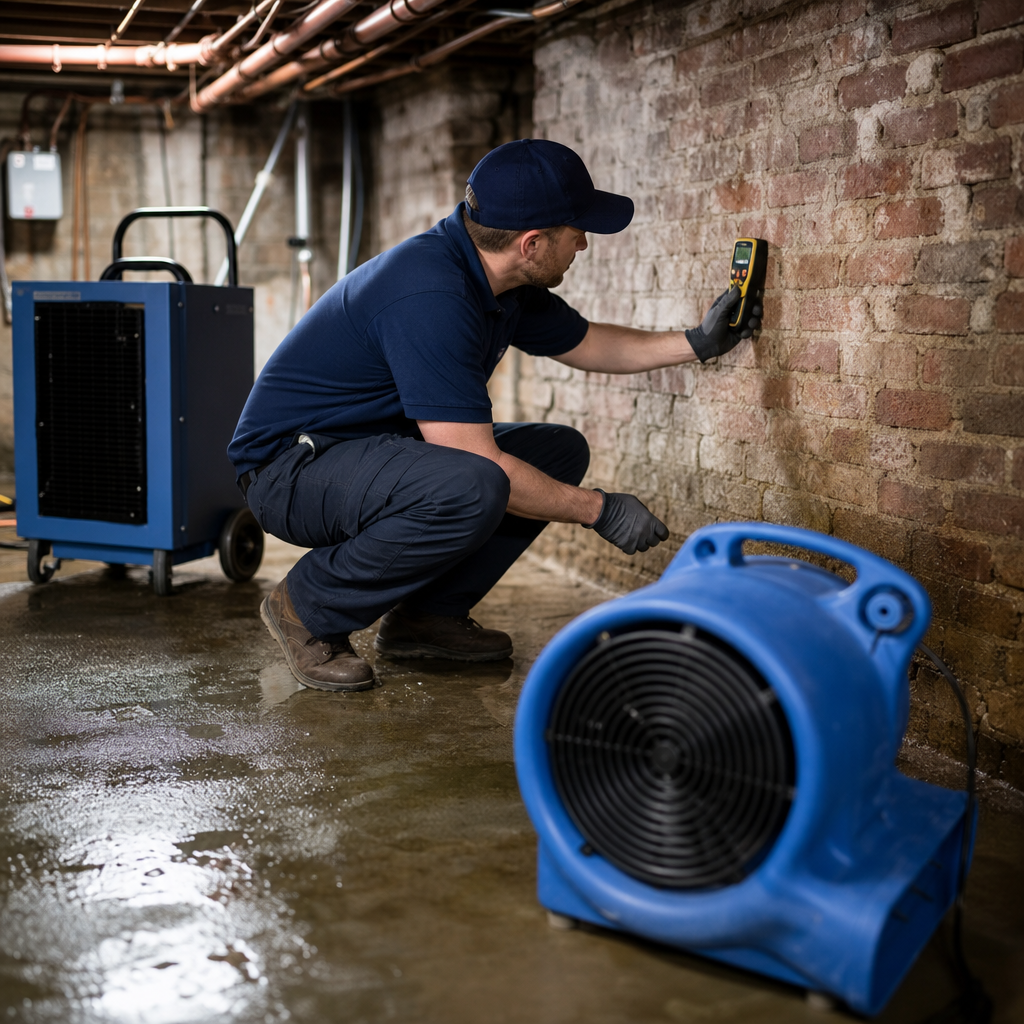
Once on site, certified technicians complete an immediate visual and moisture assessment. Using FLIR thermal cameras and non-penetrating moisture meters, we track every path the water took behind walls and under floors. We run high-volume extraction units to remove pooled water, apply EPA-registered antimicrobials to prevent mold growth, and position commercial Low-Grain Refrigerant (LGR) dehumidifiers alongside directional air movers to begin drying the structure immediately.
Salvaging Drywall and Ceilings: Repair vs Replacement Rules
According to Wade’s Restoration, deciding whether wet wall assemblies can be dried in place or require removal depends on the type of material, how long it stayed wet, and the source of the water. While standard gypsum board loses its structural integrity quickly when submerged, historic plaster can often handle wetting if forced airflow reaches the stud cavities before mold develops.
Identifying Sagging Plaster and Hidden Moisture Pockets
In older Brooklyn properties, water often travels between floorboards and collects on top of plaster ceilings below. Because horsehair plaster is dense, it holds substantial water weight. Technicians use infrared scanning to pinpoint these hidden water pockets without punching exploratory holes across your ceiling. If the plaster keys (the mechanical bonds holding plaster to wood lath) remain intact, we can dry the wall cavity from inside the joist bays, preserving historical architecture and reducing total claim costs.
When In-Place Drying Works vs When Controlled Removal Is Required
To prevent microbial growth and drywall sagging, restoration technicians evaluate materials using clear structural benchmarks:
| Condition Factor | In-Place Structural Drying | Controlled Removal (Flood Cut) |
|---|---|---|
| Material Integrity | Plaster is solid and securely keyed; drywall remains firm with moisture readings dropping during the first 24 hours. | Drywall core is soft, spongy, sagging under water weight, or separating from screws and framing studs. |
| Water Quality & Insulation | Clean supply-line water with no wet insulation or closed-cell vapor barriers trapping water inside the wall. | Wet blown-in cellulose or fiberglass batt insulation inside exterior walls, contaminated water, or visible mold growth. |
Restoring Hardwood Floors and Subfloors Without Destructive Demolition
You do not always have to tear out original hardwood floors after a pipe freeze or sudden leak. When caught early, specialized drying equipment can pull moisture directly out of both the finish planks and the underlying subfloor, flattening warped boards and restoring original wood.
Cupping vs Crowning in Flooded Hardwood
When water gets beneath hardwood planks, the underside of the wood absorbs moisture faster than the top face, expanding the bottom edges and creating a concave shape known as cupping. Crowning occurs when the center of the board arches upward, often caused when wet floors are prematurely sanded before the subfloor has reached its dry standard. Identifying these moisture gradients with deep-probe meters ensures drying goals are met before any refinishing takes place.
Specialized Mat Drying Systems vs Subfloor Tear-Outs
Rather than ripping up antique parquet or tongue-and-groove oak boards, our technicians use high-pressure negative suction floor mats. These mats create an airtight seal over the floor, pulling water vapor straight up through the grain from the subfloor beneath. This method saves original woodwork, shortens project timelines, and keeps repair expenses low.
| Feature | Negative-Pressure Mat Drying | Subfloor Tear-Out & Rebuild | Surface Air Movers Only |
|---|---|---|---|
| Cost Impact | Low to moderate | High (Full material replacement) | Low initially, high long-term repair costs |
| Living Disruption | Minimal (3 to 5 days of equipment run-time) | Significant (Weeks of construction and dust) | Moderate noise with incomplete results |
| Preservation | Saves original and historic hardwood | Historic materials are lost completely | Causes permanent cupping, buckling, and rot |
| Typical Turnaround | 60 to 90 hours | 2 to 4 weeks | Leaves hidden moisture underneath |
Basement and Crawl Space Flooding: Preventing Mold and Structural Decay
Subgrade areas like garden-level apartments, brownstone basements, and commercial stockrooms present unique challenges when a pipe breaks overhead. Water runs down through framing and collects on concrete slabs, where humidity levels spike rapidly and put structural joists at risk.
Category 1 Clean Water Degradation to Category 3 Hazards
Water from a clean domestic supply line starts as Category 1. However, once that water flows through dirty wall cavities, over dusty subfloors, or across below-grade concrete slabs, it mixes with organic matter, soil, and dust. Within 24 to 48 hours, standing water degrades into Category 2 (gray water) or Category 3 (black water), creating a biological hazard that requires deep sanitization and professional containment.
The 24 to 48 Hour Mold Colonization Timeline
Mold spores require only moisture, organic food (like wood framing, paper backing, or cardboard boxes), and warm temperatures to colonize. In enclosed basements, running standard household fans is not enough. We deploy commercial desiccant or LGR dehumidifiers to pull humidity levels below 50%, set up HEPA air filtration to trap airborne particles, and treat affected framing with EPA-registered antimicrobials to protect your indoor air quality.
What Does Burst Pipe Cleanup Cost?
Professional burst pipe cleanup typically ranges from $3,000 to $15,000 for standard residential and small commercial spaces. Final pricing depends on water volume, how many floors the leak traveled through, whether specialized hardwood mat drying is needed, and how quickly extraction begins.
Standard Cost Ranges by Restoration Service
| Restoration Service | Estimated Cost Range |
|---|---|
| Initial inspection & thermal moisture assessment | $150 – $500 |
| Emergency water extraction & structural drying (per room) | $1,200 – $4,500 |
| Hardwood floor mat extraction system setup | $1,500 – $3,800 |
| Antimicrobial structural treatment & mold prevention | $800 – $2,500 |
| Complete structural mitigation (multi-room clean water claim) | $3,000 – $15,000 |
Every property is different. Call Wade’s Restoration to arrange an immediate, no-obligation visual inspection and an accurate on-site quote.
Key Factors That Influence Your Final Claim
Most standard homeowners and commercial property policies cover sudden and accidental pipe bursts, including water extraction, structural drying, and necessary rebuild services. To avoid claim delays, our team documents the loss from the moment we arrive. We compile line-item estimates in Xactimate (the software adjusters use), take daily moisture readings, and provide photographic proof of all saved versus replaced materials, helping your claim move forward without unnecessary friction.
Frequently Asked Questions About Burst Pipe Cleanup
How much does burst pipe cleanup cost in Brooklyn, NY?
Mitigation for a burst pipe in Brooklyn typically costs between $3,000 and $12,000. Multi-story brownstone leaks and older properties with plaster walls or subfloor water travel fall on the higher end of the range due to the drying equipment required.
Who should I call first: a plumber or a water restoration company?
Shut off your main valve and call both immediately. A licensed plumber must repair or replace the split pipe, while Wade’s Restoration handles the water extraction, moisture mapping, and structural drying to keep damage from spreading.
Does property insurance cover burst pipe water damage?
Yes, standard homeowner and commercial property policies cover sudden and accidental water damage caused by burst pipes. We work directly with your insurance provider, submitting standardized documentation and daily moisture logs to streamline your claim.
How long does the structural drying process take?
Most residential and commercial properties dry out within 3 to 5 days. We monitor moisture levels every 24 hours to confirm that wood, plaster, and subfloors have reached safe baseline dry standards before removing the drying equipment.
How quickly does mold grow after a pipe bursts?
Mold spores can germinate and begin spreading within 24 to 48 hours in warm, wet conditions. Starting commercial water extraction and dehumidification immediately eliminates the humidity mold needs to grow.
Frequently Asked Questions
Can Wade's Restoration bill my property insurance company directly for burst pipe cleanup?
Yes, Wade's Restoration uses Xactimate, the industry-standard software required by major insurance carriers, to submit itemized estimates directly to your adjuster. Our technicians supply date-stamped thermal photos and daily moisture mapping logs to ensure your water extraction and drying claim moves forward smoothly without out-of-pocket delays.
How do restoration technicians find hidden water inside walls without tearing them down?
Wade's Restoration uses non-invasive FLIR thermal imaging cameras and deep-probe moisture meters to trace moisture behind plaster, drywall, and baseboards without invasive demolition. This diagnostic process locates trapped moisture pockets within joists and wall cavities so targeted drying systems can be deployed immediately.
What happens if water from a burst pipe sits for more than 48 hours before extraction?
Standing water degrades from Category 1 clean water into Category 2 or 3 biohazard water after 48 hours, fueling rapid mold growth and weakening structural framing. Wade's Restoration addresses aged leaks with hospital-grade antimicrobial sanitization, HEPA air filtration, and industrial dehumidifiers to eliminate contaminants and safely restore indoor air quality.
About the author
 |
David Thorne David Thorne is a certified restoration professional with over 12 years of experience in the property damage industry. Holding a degree in Construction Management from the New York Institute of Technology, he specializes in structural drying and mold remediation. David’s extensive background in managing both residential and commercial losses ensures practical, actionable advice for property owners navigating unexpected disasters. |
Water damage, flood, or mold emergency?
We’re available now - call for a fast, free estimate.
Call Now - Free Estimate