
Quick Summary
Understanding the water extraction cost per square foot is critical after a leak or flood, with typical restoration and drying rates ranging from $3.50 to $7.50 per square foot depending on the water contamination category. Wade's Restoration provides transparent line-item pricing and specialized non-destructive extraction systems that remove trapped moisture from subfloors and framing without costly, unnecessary teardowns. Readers will learn how structural materials influence extraction expenses and can contact Wade's Restoration 24/7 for immediate emergency extraction or a free visual inspection with an itemized scope of work.
Water Extraction Cost Per Square Foot: Save Your Floors Fast
Available 2026 sources estimate water damage restoration or extraction and drying at about $3.50 to $7.50 per square foot, with clean water lower and black water higher. Clean water runs from $3.75 to $4.25 per square foot, gray water ranges from $4.10 to $6.50 per square foot, and black water costs from $7.00 to $7.50 per square foot. Extraction alone is often not priced as a standalone national benchmark and is commonly bundled with drying or full restoration services. Acting promptly within the first 24 to 48 hours is a critical step in helping save your flooring from extensive replacement. While many national call centers and aggressive contractors will immediately push to gut your space, standing water does not mean your historic hardwood, tile, or subfloors are automatically ruined.[1]
At Wade’s Restoration, our crews use specialized extraction mats and drying systems to pull trapped moisture out of subfloors and framing without unnecessary teardown. With rapid dispatch across Williamsburg and nearby Brooklyn neighborhoods, we stabilize your property fast. We provide clear visual inspections and itemized scopes of work designed to align with standard insurance billing guidelines. See also Water Damage Repair Cost – 10% Off & Free Estimate – On-Site in 60 Minutes.
Do not let standing water settle into your subfloors or let inflated contractor bids drain your budget. Call Wade’s Restoration now for 24/7 emergency water extraction, or contact us to schedule an on-site inspection and written estimate.
Water Extraction Pricing Breakdown
Need water extraction cost per square foot?
We’re available now - call for a fast, free estimate.
Quick Pricing Overview: Available 2026 sources estimate water damage restoration or extraction and drying at about $3.50 to $7.50 per square foot. Category 1 clean water averages $3.75 to $4.25 per square foot, Category 2 gray water averages $4.10 to $6.50 per square foot, and Category 3 black water ranges from $7.00 to $7.50 per square foot. Extraction alone is often not priced as a standalone national benchmark and is commonly bundled with drying or full restoration services. Total project costs depend on water contamination levels, the type of flooring material, and whether moisture has traveled into structural assemblies.
Standard restoration rates reflect both the contamination level of the water and how deep moisture has migrated into building assemblies. Quoting extraction as simple surface-level puddle removal can be misleading, especially in older properties where moisture can penetrate multi-layer subfloors, plaster, and drywall.
| Water Category | Average Cost / Sq. Ft. | Common Sources | Typical Equipment & Action Required |
|---|---|---|---|
| Category 1 (Clean) | $3.75 – $4.25 | Supply line bursts, faucet overflows, rainwater | Weighted extractors, commercial air movers, LGR dehumidifiers; dry in place |
| Category 2 (Gray) | $4.10 – $6.50 | Washing machine discharge, dishwasher leaks, sump overflows | Antimicrobial treatments, deep extraction, carpet padding removal |
| Category 3 (Black) | $7.00 – $7.50 | Sewage backups, street flooding, stagnant water | Full PPE, negative air machines, removal of porous materials, sanitization |
Why Flat Surface Pricing Can Be Misleading
A simple per-square-foot estimate on a quote sheet often hides the real drivers of restoration costs. The surface water you see is usually only part of the problem:
- Subfloor Trapping: Water seeps between floorboards and can become trapped between the hardwood and the subfloor layers below.
- Vertical Cavity Wicking: Drywall and plaster can draw moisture upward into wall cavities.
- Contamination Escalation: Clean Category 1 water left unaddressed over time can degrade into Category 2 or 3 as it comes into contact with building materials and organic matter.
How Floor Materials and Structural Cavities Change Extraction Costs
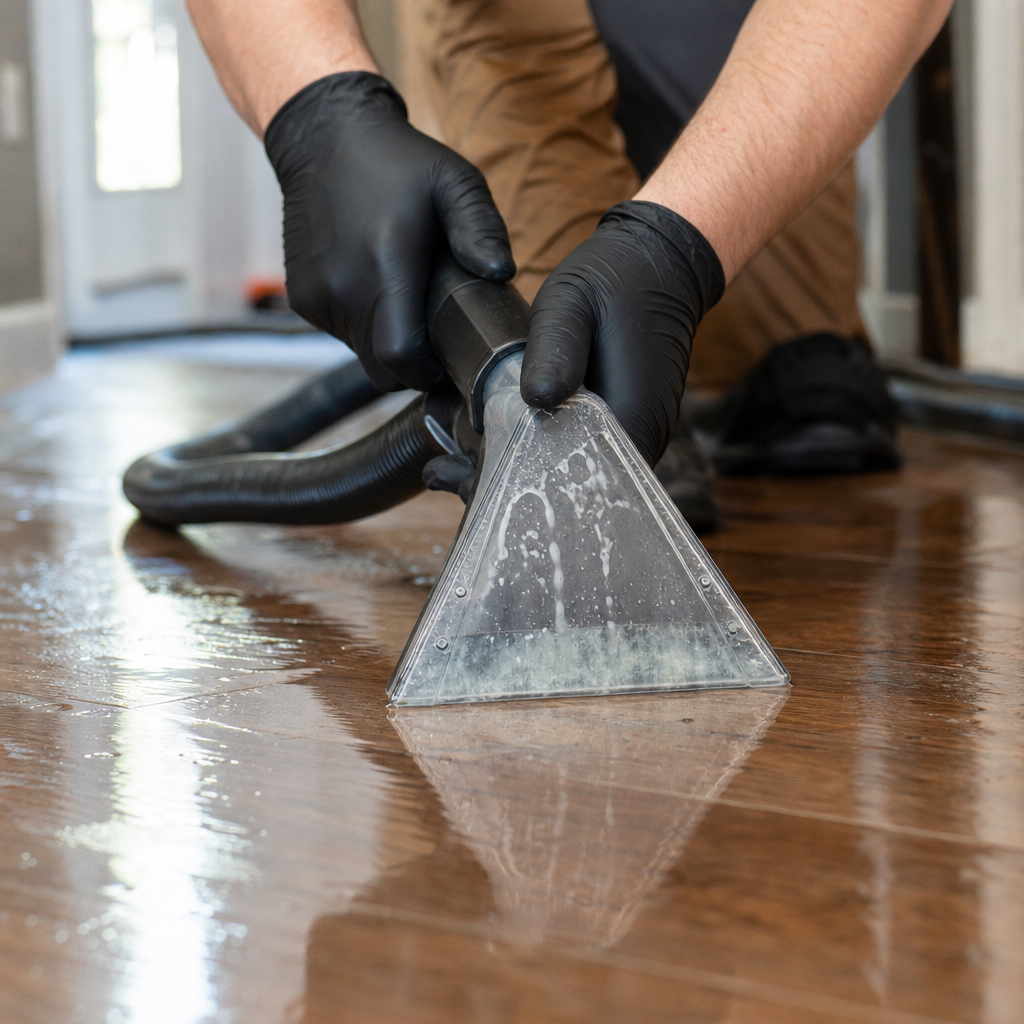
The materials under your feet dictate your final bill much more than the depth of the puddle on top. As Wade’s Restoration points out, bare concrete in a basement allows for rapid extraction and drying, but layered hardwood, tongue-and-groove pine, and enclosed plaster walls demand specialized extraction methods to prevent permanent warping.
Carpet and Padding vs. Concrete Slabs
Extracting standing water from carpeting generally costs between $1.00 and $2.50 per square foot when quoted for surface removal steps alone. If the pad underneath is saturated with gray or black water, it typically must be removed and discarded, though clean water can often be dried in place with weighted extraction tools. Concrete slabs in basements or commercial spaces require heavy vacuum extraction, but because concrete is non-porous compared to wood, drying time and disposal costs remain lower.
Saving Hardwood Floors in Historic and Loft Buildings
Many contractors default to ripping up hardwood floors as soon as they see cupping. This inflates rebuild costs significantly. Using high-pressure vacuum extraction mats and heat injection systems allows technicians to draw water straight up through the wood grain and subfloor without tearing up original planks.
| Substrate Material | Destructive Contractor Approach | Non-Destructive Restoration Approach |
|---|---|---|
| Hardwood & Parquet | Immediate rip-out and replacement ($12-$25/sq ft rebuild) | Targeted vacuum extraction mats and desiccant drying to flatten and save planks |
| Carpet & Underlayment | Total tear-out of carpet, pad, and subfloor | Weighted suction extraction; pad replacement only if contaminated |
| Drywall & Plaster Walls | 4-foot flood cuts around the entire room perimeter | Baseboard removal, precision cavity injection drying, and directed airflow |
Drywall and Vertical Moisture Migration
Water does not stay flat on the floor. Through capillary action, moisture can climb upward into baseboards, framing, and insulation following a pipe burst or backup. Determining an accurate water extraction and restoration cost requires checking inside these enclosed cavities with non-invasive moisture meters and thermal imaging to help prevent secondary damage and avoid unnecessary wall replacement.
Water Extraction vs. Structural Drying and Insurance Claims
Need water extraction cost per square foot?
We’re available now - call for a fast, free estimate.
Emergency water extraction removes standing surface liquid, but structural drying addresses bound moisture inside floor joists, framing, and subflooring. Relying solely on basic surface removal can leave elevated humidity in the structure.
Phase 1: Emergency Water Removal
- Bulk liquid extraction: High-powered truck-mounted or portable extraction units pull standing water off surfaces and out of carpet fibers.
- Containment: Setting up containment barriers helps prevent humidity from spreading into unaffected rooms.
Phase 2: Structural Drying and Dehumidification
- Evaporation: Industrial air movers direct airflow across damp materials to lift trapped moisture into the air.
- Dehumidification: Low-grain refrigerant (LGR) or desiccant dehumidifiers pull moisture out of the air to support structural drying.
Insurance Coverage and Claim Documentation
Water damage is a frequent source of property insurance claims. Most standard commercial and homeowner policies cover sudden and accidental water events, such as burst supply lines or failed water heaters. When filing a claim, providing detailed documentation – such as moisture tracking readings, itemized scopes of work, and timestamped photos – helps support the review process. Working with a mitigation team like Wade’s Restoration that supplies organized documentation directly assists in keeping your claim organized.
Frequently Asked Questions
What is the average water extraction cost per square foot?
Available 2026 sources estimate water damage restoration or extraction and drying at about $3.50 to $7.50 per square foot, with clean water lower and black water higher. Category 1 clean water averages $3.75 to $4.25 per square foot, Category 2 gray water averages $4.10 to $6.50 per square foot, and Category 3 black water ranges from $7.00 to $7.50 per square foot. Extraction alone is often not priced as a standalone national benchmark and is commonly bundled with drying or full restoration services.
What is the difference between water extraction and water mitigation?
Water extraction refers specifically to the physical removal of standing surface water using vacuum pumps and extraction tools. Water mitigation encompasses the complete process: extraction, structural dehumidification, antimicrobial application, moisture tracking, and stabilizing building materials to prevent further structural damage.
Does property insurance cover the cost of emergency water extraction?
Yes, many commercial property and homeowners insurance policies cover emergency water extraction if the source was sudden and accidental (such as a burst pipe or appliance malfunction). Standard policies generally exclude gradual leaks or unmitigated maintenance issues.
How much does carpet water extraction cost compared to hardwood?
Carpet water extraction alone typically costs $1.00 to $2.50 per square foot, though contaminated pad removal increases total costs. Hardwood restoration requires specialized suction mat systems and thorough drying, but can save significant expense compared to complete hardwood replacement.
How quickly must water extraction begin to save the floors?
Extraction and mitigation should begin promptly, ideally within the first 24 to 48 hours, to minimize structural damage, warping of wood materials, and the risk of microbial growth.
Protect your residential or commercial property from long-term structural damage. Contact Wade’s Restoration 24/7 for fast emergency extraction, thorough moisture tracking, and transparent pricing.
Need water extraction cost per square foot?
We’re available now - call for a fast, free estimate.
Sources
- Geosci. Model Dev., 18, 1737-1767, 2025 – gmd.copernicus.org (2025)
Related reading: Sewage Backup Cleanup Cost | Call Now-10% Off | Same-Day Service | Free Estimate
Frequently Asked Questions
How do technicians detect hidden moisture beneath subfloors without tearing them up?
Restoration professionals use non-invasive tools like infrared thermal cameras and calibrated pinless moisture meters to track water migration beneath finished flooring. Wade's Restoration offers detailed visual inspections with moisture mapping to identify trapped water without causing unnecessary structural damage.
Can cupped hardwood floors be completely flattened without full replacement?
Yes, if mitigation starts within 24 to 48 hours, targeted vacuum extraction mats and desiccant dehumidification can draw trapped water out of the subfloor and wood grain. Wade's Restoration uses these non-destructive drying systems to save original planks, avoiding costly rebuild expenses that often reach $12 to $25 per square foot.
How can property owners avoid unexpected out-of-pocket costs during insurance water claims?
To prevent denied claims and billing surprises, property owners must supply detailed daily moisture logs, timestamped photos, and industry-standard line-item scopes. Wade's Restoration provides transparent, itemized documentation aligned with insurance guidelines to help ensure your claim is fully supported.
About the author
 |
Sarah Miller Sarah Miller is a restoration specialist with over 8 years of experience in the property damage industry. She holds an Associate Degree in Construction Management from New York City College of Technology. Sarah specializes in educating homeowners and property managers on the complexities of water damage restoration and the associated costs, helping them navigate emergency situations with clarity. |
Water damage, flood, or mold emergency?
We’re available now - call for a fast, free estimate.
Call Now - Free Estimate