
Quick Summary
Standing water from sudden pipe bursts or flooding rapidly degrades building materials within 24 to 48 hours, making immediate emergency water removal crucial to prevent severe structural rot and mold colonization. Wade's Restoration provides 24/7 live local dispatch with rapid 45-minute on-site response, utilizing advanced non-invasive drying systems to extract moisture from deep subfloors, joists, and historic materials without destructive tear-outs. Property owners can safeguard their building assets, expedite insurance claims with standardized moisture logs, and call Wade's Restoration's 24/7 hotline for immediate emergency dispatch and a free visual inspection.
Emergency Water Removal Near Me: Fast Response
If you are searching for emergency water removal near me right now, professional extraction teams provide 24/7 water extraction and structural drying services. Mitigation specialists start with an on-site assessment and document damage for insurance carriers so you can focus on your property and safety. According to FEMA and National Flood Insurance Program estimates, just one inch of standing water in a typical home can cause up to $25,000 in damage. When water sits, building framing weakens, subfloors warp, and mold takes hold fast.[1]
You do not have time to wait on hold or deal with an aggressive contractor whose first move is gutting your entire room. Professional mitigation teams focus on non-invasive structural drying to save original plaster, baseboards, and historic hardwood floors whenever possible. Trained technicians at Wade’s Restoration use extraction units to remove standing water quickly and protect your property from secondary decay. Contact an emergency restoration service right away to get a crew dispatched.[4] See also Water Damage Restoration Williamsburg – Call Now-10% Off – Same-Day Service – Free Estimate.
Emergency Water Removal: Immediate Action and What to Expect
When dealing with standing water from a burst pipe, storm surge, or sewer backup, take immediate safety steps before the team arrives. Shut off your main water valve and turn off electricity to flooded rooms at the breaker panel, provided you can reach the switch safely without stepping in standing water. Once on-site, professional extraction crews use heavy-duty pumps to draw out bulk water, set up drying systems, and stabilize humidity levels before mold can colonize.
Searching for emergency water removal near me usually means water is actively migrating through floorboards, ceilings, or drywall. Fast, non-invasive extraction helps protect historic lath-and-plaster walls and original flooring from unnecessary demolition while generating the moisture data your insurance adjuster requires.
Immediate Triage Checklist While Waiting for Extraction
- Isolate Utilities: Shut off the main water supply and switch off power to the affected areas at the breaker box if the pathway is dry and safe.
- Document the Scene: Capture clear photos and video of standing waterlines, soaked trim, wet furniture, and damaged inventory before anything is moved.
- Mobilize Extraction: Call 24 hour water extraction services right away to halt deep structural absorption into joists and subflooring.
Key Takeaways for Property Owners in Crisis
National estimates show flooding and water disasters cost Americans more than $180 billion in damages annually. Rapid extraction removes moisture before mold remediation becomes unavoidable. Whether you are dealing with a clean supply-line failure or complex fire and smoke damage recovery involving heavy water saturation, prompt professional dispatch from teams like Wade’s Restoration helps mitigate damage without unnecessary delays.[2]
How Fast Can an Emergency Water Extraction Crew Arrive?
Need emergency water removal near me?
We’re available now - call for a fast, free estimate.
In a water emergency, every minute counts. Fast action prevents moisture from penetrating deep into wall cavities, floor joists, and structural sill plates. Mold spores can germinate on wet drywall, plaster, and subflooring within 24 to 48 hours of initial exposure, turning a simple extraction into a lengthy remediation project.
The 48-Hour Mold and Structural Decay Window
Speed determines whether your floor can be dried in place or must be torn out down to the structural beams. Category-1 clean water from a supply line quickly degrades into Category-2 gray water or Category-3 black water within 24 to 48 hours as it picks up dirt, bacteria, and building contaminants. Prompt extraction keeps clean water from becoming a biohazard.
Why Live Local Dispatch Beats National Call Centers
When you need emergency water removal near me, third-party brokers often route calls through distant call centers lacking local knowledge and direct fleet management. That delay lets water soak deeper into your subfloors.
| Response Factor | Direct Local Dispatch | Third-Party Call Centers |
|---|---|---|
| Arrival Speed | Prompt local mobilization to the site | Potential delays due to remote routing and subcontracting |
| Dispatch Protocol | Direct communication with available technicians | Automated phone trees and third-party call handlers |
Immediate water pump-outs prevent secondary microbial growth and protect your real estate value alongside specialized recovery services.
Restoring Historic Hardwood Floors and Plaster: Non-Invasive Drying vs. Demolition
Prewar buildings and converted lofts feature historic materials that cannot simply be picked up at a modern supply yard. Vintage oak flooring, heart-pine planks, and original plaster walls can often be preserved if water mitigation starts quickly. Technicians use commercial floor mat systems and targeted dehumidifiers to draw trapped moisture out of joists and subfloors from above. This helps prevent boards from cupping or crowning without gutting architectural details.
| Feature | Non-Invasive Mat Drying | Invasive Demolition | Standard Air Movers Alone |
|---|---|---|---|
| Historic Wood Preservation | Preserved in place when feasible | Completely removed | High risk of permanent cupping |
| Subfloor Joist Extraction | Negative-pressure pull | Exposed through gutting | Surface-only evaporation |
| Disruption and Claim Timeline | Often dried in days | Extended weeks of reconstruction | Risk of lingering secondary moisture |
Hardwood, Subfloors, and Joist Moisture Extraction
Some contractors instinctively tear out wet hardwood during an insurance claim. Instead, industrial suction mats can draw water straight through the wood grain from the subfloor beneath. Extracting water quickly preserves the physical integrity of the wood and keeps the overall scope of repairs contained.
Protecting Prewar Plaster Walls vs. Standard Drywall
Unlike modern sheetrock that crumbles when wet, historic lath-and-plaster retains much of its structural strength if dried under controlled humidity and temperature, as specialists at Wade’s Restoration note. Professional extraction services deploy high-capacity drying units to pull moisture out of hidden wall cavities before fungi can settle and require full mold remediation.
Why Unnecessary Structural Tear-Outs Hurt Property Value
Ripping out original trim, vintage moldings, and custom woodwork can devalue historic properties and extend repair times. A preservation-focused approach protects property character, echoing the careful salvage methods used during property recovery.
What Does Emergency Water Removal Cost?
Need emergency water removal near me?
We’re available now - call for a fast, free estimate.
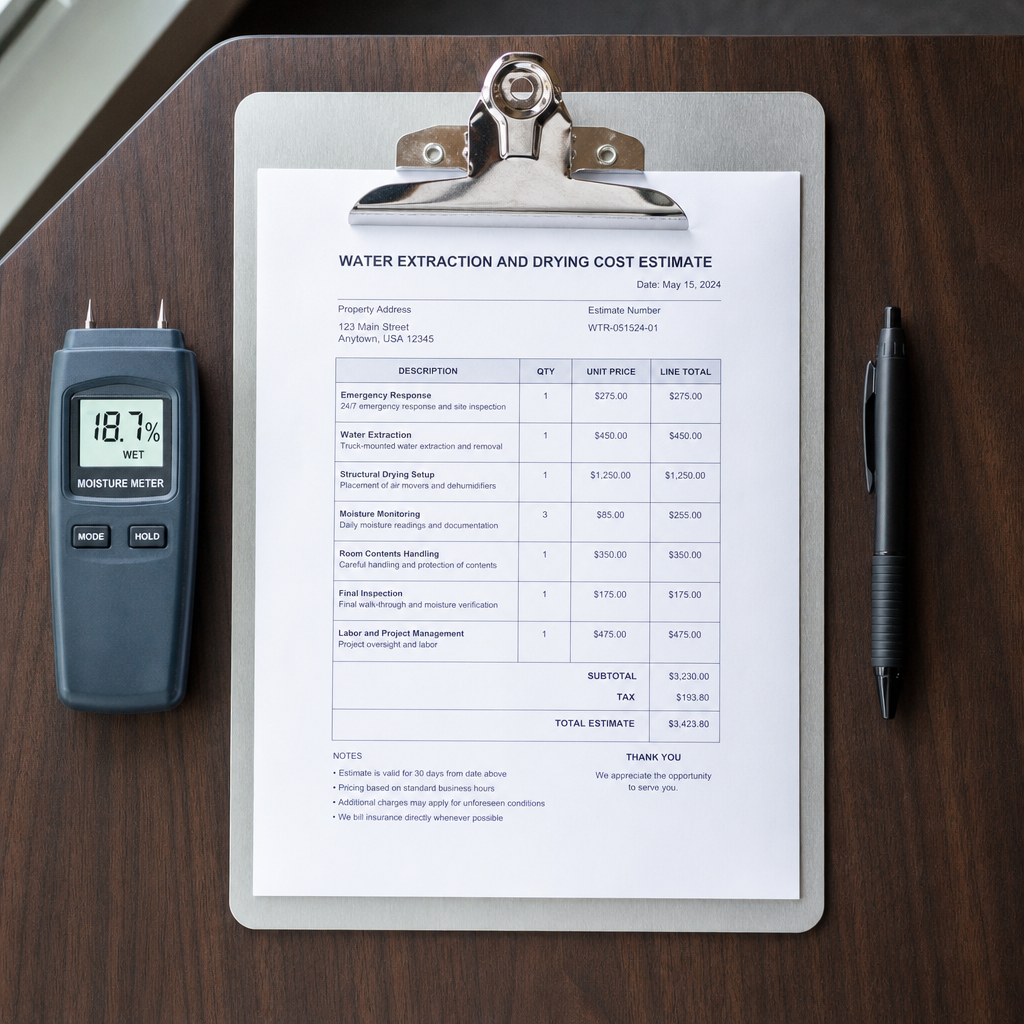
Emergency water removal generally runs between roughly $1,300 and $6,400 nationwide, with most standard projects falling within $1,500 to $7,000 depending on the severity of the damage. Final costs depend on the water category, total square footage, material porosity, and the specialized drying units required to prevent structural rot.
Standard Cost Ranges by Restoration Category
When evaluating emergency water removal near me, pricing reflects the contamination level, equipment deployed, and depth of structural saturation:
| Service Type | Estimated Cost Range | Primary Mitigation Focus |
|---|---|---|
| Visual Assessment & Scope | Varies / Included in Scope | Moisture mapping and line-item scope estimation |
| 24 Hour Water Extraction Services | $1,300 – $3,500 | Water extraction and non-invasive subfloor drying |
| Mold Remediation & Containment | $1,500 – $6,000 | HEPA containment, air scrubbing, and treatment |
| Category 3 / Contaminated Cleanup | $2,000 – $7,000 | Biohazard removal, sanitization, and disposal |
| Structural Mitigation & Drying | $1,500 – $7,000 | Targeted drying, cavity extraction, and dehumidification |
How Moisture Logs and Line-Item Billing Protect Insurance Claims
Water damage and freezing account for nearly a quarter of all property insurance claims nationwide. Sudden and accidental pipe bursts or appliance failures are typically covered under standard property policies, whereas flood waters or long-term neglect are excluded without specific endorsements. With flood-related damages reaching massive totals every year, accurate documentation protects you from unexpected out-of-pocket costs.[3]
Professional restoration specialists support property claims with detailed documentation:
- Moisture Mapping: Thermal and moisture meters locate hidden moisture pockets behind walls and beneath floors.
- Standardized Line-Item Billing: Estimates are formatted using standard pricing guidelines recognized by major insurance adjusters.
- Carrier Coordination: Daily psychrometric logs are supplied to support claim processing.
Non-invasive drying protects original property features while providing your insurer with objective proof of loss.
Protecting Commercial Continuity and Multi-Unit Properties
A water emergency in a commercial space or apartment building requires immediate intervention to halt revenue loss and prevent tenant displacement. Following established industry standards, professional emergency water removal from providers like Wade’s Restoration stabilizes framing, flooring, and inventory to keep operations running.
Minimizing Downtime for Retail and Restaurants
For commercial facilities, retail spaces, and restaurants, every day closed means lost revenue, spoiled inventory, and payroll stress. Professional extraction crews deploy commercial drying units to remove water promptly. Crews take daily psychrometric readings to dry commercial spaces safely, preventing extended closures and subsequent mold remediation.
Single-Source Recovery: From Water Pump-Out to Structural Repair
Managing multiple independent mitigation and carpentry teams can cause communication breakdowns and claim delays. Comprehensive restoration providers coordinate the process from initial extraction through structural drying and repairs. This organized workflow keeps documentation consistent and helps reopen properties faster.
Frequently Asked Questions About Emergency Water Removal
How much does emergency water removal cost on average?
Nationwide, standard water extraction and drying typically costs between roughly $1,300 and $6,400, with broader mitigation scopes averaging $1,500 to $7,000. Choosing non-invasive structural drying over premature demolition lowers rebuild expenses, shortens recovery time, and protects original building materials.
Does homeowners or commercial property insurance cover water extraction?
Most standard policies cover sudden and accidental discharge, such as a burst supply line, water heater rupture, or boiler failure. Gradual leaks and exterior surface flooding usually require specific riders. Restoration contractors provide photographic logs, moisture readings, and documentation to support your claim.
What equipment is used to extract standing water and dry the structure?
Restoration teams use industrial vacuum extractors, dehumidifiers, high-velocity air movers, and specialized negative-pressure floor mat systems to dry subfloors and wall cavities without unnecessary demolition.
How do professionals prevent mold growth after water damage?
Technicians remove standing water immediately, lower relative humidity using industrial dehumidification, and apply appropriate antimicrobial treatments during 24 hour water extraction services to stop spores from multiplying.
When searching for emergency water removal near me, select a team experienced in both residential and commercial structures. Professional restoration teams like Wade’s Restoration provide 24/7 emergency response and insurance documentation support. Contact a trusted mitigation provider promptly to protect your property.
Need emergency water removal near me?
We’re available now - call for a fast, free estimate.
Sources
- Just 1 inch of floodwater of damage to your home. – agents.floodsmart.gov (2023)
- Weather Related Fatality and Injury Statistics – weather.gov
- 2025 in Review: U.S. Billion-Dollar Disasters | Climate Central – climatecentral.org (2025)
- Flash Flood: Peak 2025, 1,089 Deaths, $81.6B – PlainHazard – plainhazard.com (2025)
Related reading: Water Damage Restoration Brooklyn Ny – 10% Off & Free Estimate – Same-Day Service
Related reading: Fire Damage Restoration Cost | Call Now-10% Off | Same-Day Service | Free Estimate
Related reading: Emergency Flood Restoration | Call Now-10% Off | On-Site in 60 Minutes | Free Estimate
Frequently Asked Questions
How quickly will an emergency water extraction crew arrive at my property?
Wade's Restoration operates 24/7 direct local dispatch to guarantee certified technicians arrive on-site within 45 minutes of your call. This rapid response halts water migration through subfloors and framing before secondary microbial growth or structural rot can develop.
Can saturated hardwood floors and plaster walls be restored without demolition?
Yes, if mitigation begins within the critical 24- to 48-hour window before irreversible warping and mold colonization occur. Wade's Restoration deploys specialized negative-pressure floor mat systems and industrial cavity dehumidifiers to draw trapped moisture straight out of subfloors and prewar plaster without invasive tear-outs.
What documentation do insurance companies require to approve emergency water removal claims?
Carriers require objective proof of damage and proper mitigation, including thermal imaging moisture maps, daily psychrometric logs, and standardized line-item estimates. Wade's Restoration provides complete claim-ready documentation and direct coordination with adjusters starting from the initial free visual inspection.
About the author
 |
Sarah Miller Sarah Miller is a restoration specialist with over 8 years of experience in the property damage industry. She holds an Associate Degree in Construction Management from New York City College of Technology. Sarah specializes in educating homeowners and property managers on the complexities of water damage restoration and the associated costs, helping them navigate emergency situations with clarity. |
Water damage, flood, or mold emergency?
We’re available now - call for a fast, free estimate.
Call Now - Free Estimate