
Quick Summary
When plumbing failures, storm surges, or sewage backups threaten NYC facilities, rapid commercial water damage restoration is essential to prevent costly operational downtime and severe structural degradation. Wade's Restoration delivers premier 24/7 commercial emergency response with rapid 45-minute on-site mitigation across Brooklyn, Manhattan, and Queens, utilizing negative-pressure micro-containment, non-destructive in-place drying, and comprehensive insurance claim management to keep businesses operational. Facility managers and property owners can call Wade's Restoration's 24/7 dispatch line now for immediate emergency extraction or request a free visual inspection and detailed scope of work to protect their property.
Commercial Water Damage Restoration – Rapid NYC Dispatch
When standing water threatens your facility, Wade’s Restoration delivers commercial water damage restoration with rapid emergency dispatch across New York City. From immediate industrial extraction to structural drying and rebuilds, our crews work around your operating schedule to minimize operational downtime. In a multi-year analysis of over 470,000 commercial claims across 200 countries, Allianz Global Corporate & Specialty found that water damage accounted for 6% of all business insurance claims and 3% of total claim value. For a retail shop, restaurant, or office building, even a few hours of water intrusion can quickly compound into steep revenue losses.[2]
Rather than sending your call to a remote call center or hiring general contractors who default to tearing out salvageable architecture, our IICRC-certified technicians focus on drying building materials in place. Through our Claim Clarity Program, we provide line-item Xactimate scopes, detailed moisture logs, and direct insurance billing so your claim moves forward without delays. Call our 24/7 dispatch line now to get an emergency crew on the road or to schedule a visual inspection.
Commercial Water Damage Restoration: Rapid Response, Scope, and Next Steps
Commercial Water Damage Restoration in brief: Commercial water damage restoration stabilizes, dries, and sanitizes commercial buildings following plumbing failures, storm intrusion, or sewer backups. The process combines high-volume extraction, negative-pressure micro-containment, industrial dehumidification, and moisture tracking to restore safe operations quickly without unnecessary demolition.
Commercial mitigation requires fast action to protect tenant safety, inventory, and building systems. According to the FEMA Hazus Flood Model Technical Manual, business interruption losses extend well past physical repair bills, pulling in direct wage losses, temporary relocation costs, and lost rental income. Wade’s Restoration stabilizes retail storefronts, industrial lofts, and office facilities across Brooklyn, Queens, and Manhattan to contain those financial impacts immediately.
Immediate Action Steps for Facility Managers
- Isolate the source and power: Shut the main water supply valve immediately and cut power to flooded zones at the breaker panel if safe to access.
- Call for emergency mitigation: Contact an IICRC-certified commercial extraction crew promptly to help prevent water from migrating further into subfloors and wall cavities.
- Document moisture and inventory: Photograph standing water lines, affected equipment, and damaged stock before moving items to assist with filing insurance claim for water damage.
How Micro-Containment Prevents Full Business Closure
Traditional rebuild contractors often tear down entire drywall assemblies, forcing businesses to shut down and navigate lengthy NYC Department of Buildings permitting processes. We use heavy-duty poly-containment barriers under negative air pressure to isolate damaged zones. This targeted containment lets your staff continue working safely in unaffected areas while our drying systems run quietly behind sealed enclosures.
Emergency Water Damage Restoration
Emergency commercial flood cleanup stops clean supply water (Category 1) from degrading into grey (Category 2) or black water (Category 3). Saturated drywall, subflooring, and ceiling grids lose structural integrity rapidly, making early intervention essential for saving building materials.
24/7 Industrial Water Extraction Protocols
- Source Isolation: Our technicians locate and isolate pressurized supply line ruptures, failed sprinkler heads, or roof drain breaches.
- Bulk Pumping and Extraction: We deploy high-capacity, truck-mounted extraction units and portable sub-surface extractors to pull standing water from wide-span retail floors, concrete slabs, and carpeted office suites.
Stabilizing Business Continuity and Mitigating Revenue Loss
Every hour your doors remain closed drains revenue. Our commercial drying and dehumidification services apply psychrometric science, balancing relative humidity, temperature, and airflow to dry your facility in place. This avoids the cost, mess, and long permit timelines tied to full structural gutting.
Flood Damage Restoration
Commercial flood restoration contractors must handle both standing liquid and hazardous contaminants carried in from exterior street runoff. In dense urban neighborhoods, storm surges push silt, motor oils, and biological waste into ground-level storefronts and basements, requiring strict sanitization alongside deep moisture extraction.
Managing Storm Surges and External Runoff in Commercial Properties
When intense rainfall floods street corridors in Williamsburg or Lower Manhattan, water quickly penetrates porous brick facades, mortar, and concrete slabs. Rather than tearing out historic masonry, our team uses trailer-mounted desiccant dehumidifiers and high-temperature Low-Grain Refrigerant (LGR) units to pull deep moisture out of thick building assemblies.
Category 2 and Category 3 Water Decontamination
Floodwaters require structured biohazard decontamination protocols before building spaces can be reoccupied:
- Zone Micro-Containment: Setting up 6-mil poly-sheeting barriers to isolate contaminated floors and prevent cross-contamination into clean spaces.
- Antimicrobial Washdown: Applying EPA-registered botanical disinfectants across all exposed structural surfaces to eliminate bacteria and stop fungal growth.
- Daily Moisture Logging: Tracking dry-down metrics to give your insurance adjuster defensible, verified documentation.
Mold Remediation
Commercial mold remediation helps prevent fungal growth behind baseboards, dropped ceiling grids, and HVAC duct chases following water intrusion. Wade’s Restoration isolates airborne spores with negative air machines, protecting building occupants and keeping unaffected retail or office space open for business.
Commercial Microbial Containment Under Negative Pressure
When microbial activity is detected during an inspection, technicians establish strict containment protocols:
- Sealing off entryways, return vents, and structural cavities with heavy polyethylene sheeting.
- Operating industrial HEPA-filtered air scrubbers continuously under negative pressure to capture airborne particulates down to 0.3 microns.
- Conducting third-party air clearance testing to verify air quality before removing physical barriers.
EPA and OSHA Compliant Air Scrubbing and Sanitization
For facilities needing mold remediation in Williamsburg NY, our team adheres to strict OSHA guidelines and IICRC S520 standards. We clean framing and wall cavities with non-toxic, hospital-grade antimicrobials and supply complete clearance reports for tenant records and insurance files.
Sewage Cleanup
Need commercial water damage restoration?
We’re available now - call for a fast, free estimate.
Commercial sewage backups push Category 3 black water full of harmful pathogens and biohazards through floor drains and plumbing fixtures. Wade’s Restoration delivers emergency commercial water mitigation services across NYC, neutralizing biological hazards quickly to satisfy municipal health codes and protect public safety.[1]
Category 3 Black Water Extraction and Biohazard Abatement
Sewage spills in commercial kitchens, office restrooms, or retail basements demand an uncompromising cleanup protocol:
- Hazard Containment and Bulk Removal: Isolating the affected zone under negative pressure and extracting sewage using sealed recovery tanks.
- Controlled Disposal: Removing unsalvageable porous items like saturated carpeting or pad, while saving non-porous subflooring and masonry.
- Sanitization and Deodorization: Washing structural materials with hospital-grade biocides and running thermal foggers to eliminate persistent odors.
Commercial Restroom and Main Drain Decontamination
Reopening a commercial space after a drain backup requires documented proof of sanitation. We perform thorough swab testing and provide clear sanitization logs that meet NYC health department standards, making your insurance claim processing straightforward.
Fire and Smoke Damage Restoration
Commercial fire and smoke restoration tackles two problems at once: corrosive, acidic soot deposits and the thousands of gallons of water left behind by fire suppression systems. Our dual-action crews dry out building structures while cleaning soot residues before they permanently pit metals, etch glass, or ruin finished surfaces.
Soot Removal and Acidic Residue Stabilization
Soot begins degrading electronics, appliances, and fixtures within hours. We deploy industrial hydroxyl generators and specialized chemical sponges to wipe down surfaces, capture fine particulates, and neutralize odors without introducing toxic chemicals into your facility.
Combined Water Mitigation from Fire Suppression Systems
Sprinkler releases and fire hose discharge can pool several inches of water across multiple floors. Wade’s Restoration handles high-volume extraction, structural drying, and smoke odor removal under a single project manager, preventing moisture pockets from triggering mold growth later on.
Commercial Burst and Frozen Pipe Water Damage
Winter freeze snaps often cause uninsulated riser lines in older commercial properties and converted lofts to rupture, sending water cascading down through several levels. Fast stabilization relieves hydrostatic pressure in ceilings and walls, protecting original architectural details and avoiding invasive rebuilds.
Prewar Plumbing Vulnerabilities and Winter Freeze Protocols
Historic NYC commercial buildings and prewar brownstones feature exposed plumbing chases that sit close to drafty exterior walls. When winter temperatures drop, these lines can freeze and burst unexpectedly. Our crews arrive with thermal imaging cameras to trace water paths inside walls and stop hidden moisture spread before it ruins finished plaster or hardwood floors.
Non-Invasive Structural Drying for High-Traffic Facilities
Rather than tearing down expensive commercial millwork or custom plaster, we use directional air injectors and floor mat drying systems. By pumping dry, heated air directly into wall cavities through tiny, easily patched access points, we dry the building skeleton in place and keep your business operational.
Commercial Basement Flooding and Ground-Level Water Extraction
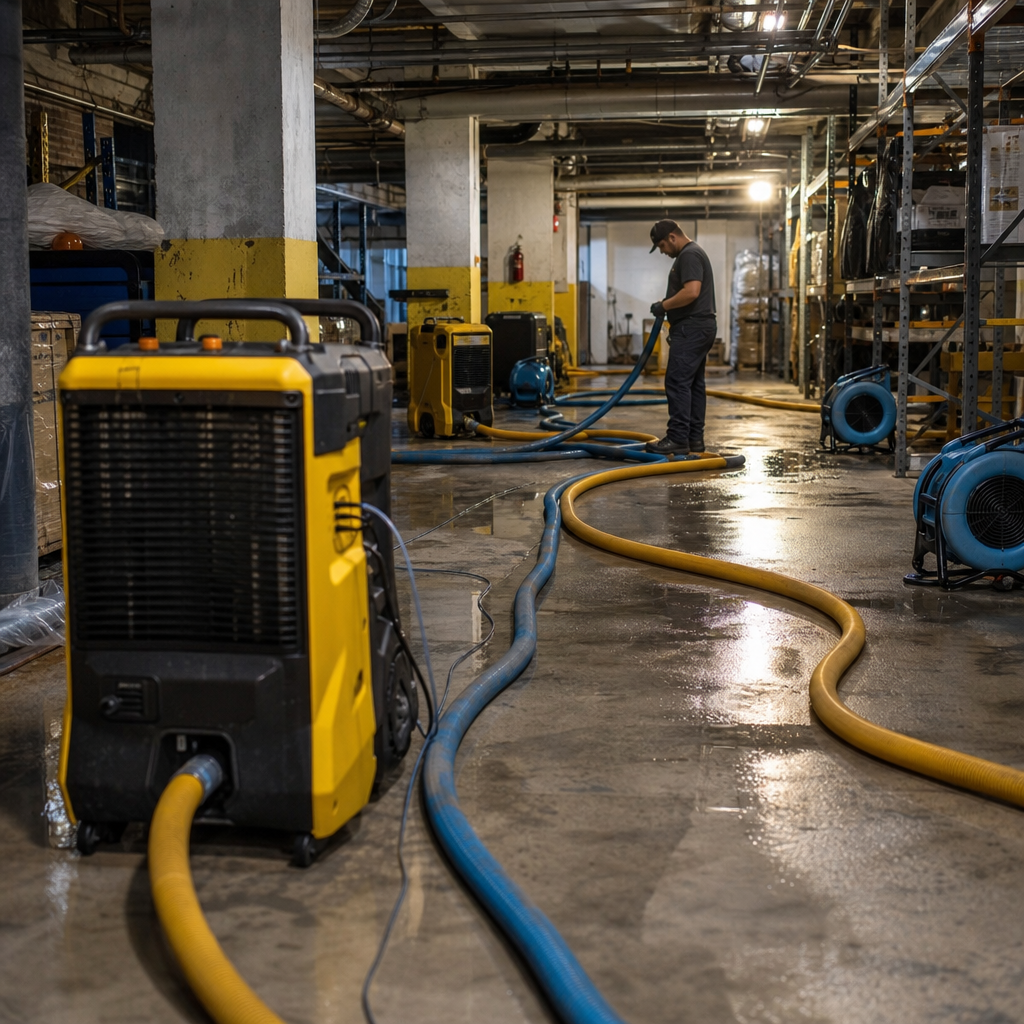
Basement water intrusion threatens critical electrical switchgear, boiler systems, and inventory storage. Rapid ground-level water extraction stops standing water from seeping into sub-grade foundations, preventing long-term foundation issues and fungal growth.
Sub-Grade Water Infiltration in Brooklyn Commercial Hubs
Along busy corridors like Bedford Avenue, shallow water tables and aging municipal storm mains can cause water to back up through slab joints and foundation walls during heavy storms. Wade’s Restoration deploys heavy submersible pumps and truck-mounted units to clear sub-grade areas quickly, keeping utility infrastructure operational.
Sump Pump Failures and Foundation Moisture Remediation
When mechanical sump pumps fail during power cuts or severe downpours, water pools rapidly around utility infrastructure. We pump out the water, apply antimicrobial coatings to concrete and block walls, and set up industrial dehumidification systems to dry out the foundation without requiring structural demolition.
Roof Leaks and Storm Damage Repair for Commercial Buildings
A severe roof leak can compromise drop ceilings, wet insulation, and flood top-floor offices in minutes. Our emergency response team pairs immediate exterior weatherproofing with interior moisture extraction to keep your building secure and operational.
Flat Commercial Roof Drainage Failures and Parapet Breaches
Flat roofs on commercial buildings can accumulate tons of standing water when scuppers or internal drains become blocked. If parapet flashing fails, water can track down interior columns across several floors. We install heavy-duty exterior covers and set up interior drainage channels to divert incoming water while extraction proceeds below.
Emergency Tarping and Ceiling Water Extraction
To prevent suspended ceiling grids from collapsing under the weight of trapped water, our technicians follow a disciplined stabilization process:
- Relieve hydraulic pressure above ceiling tiles and extract pooled water from plenum spaces.
- Install heat-welded exterior tarps over compromised roof areas to block further rain intrusion.
- Deploy desiccant drying systems to pull moisture out of structural roof decks and joists.
Mold Remediation After Commercial Water Damage
Need commercial water damage restoration?
We’re available now - call for a fast, free estimate.
When water sits unnoticed inside wall cavities or beneath flooring, moisture can lead to mold development on organic materials. Our technicians focus on quick containment and targeted in-place drying to eliminate fungal threats before they disrupt your commercial lease or cause tenant disputes.
Secondary Damage Prevention Timelines
Fast action can mean the difference between straightforward structural drying and an extensive remediation project. Using calibrated thermal cameras and penetrating moisture meters, we locate hidden wet pockets behind baseboards and casework, drying them out before microbial issues develop.
Air Quality Documentation for Commercial Tenants and Landlords
Commercial lease agreements require documented proof that indoor spaces are safe for workers and visitors. Through our Claim Clarity Program, property owners receive comprehensive psychrometric drying logs and third-party laboratory air clearance certificates to share with tenants, building management, and insurance carriers.
Fire and Smoke Damage Cleanup for Businesses
Commercial fire and smoke restoration requires immediate structural stabilization, soot removal, and mechanical system decontamination. Wade Ferris and his project managers supervise every phase of recovery, working to protect your physical plant and inventory so you can reopen sooner.
Emergency Board-Up and Structural Stabilization
Following an electrical fire or kitchen flare-up, our emergency crews secure broken windows, seal roof penetrations, and brace damaged structural openings to keep the property secure and protect against weather damage.
Ductwork and HVAC Soot Decontamination
Soot drawn into central air systems will recirculate across every room if left unaddressed. We clean and seal ductwork, change out commercial air filters, and clean air handlers with hospital-grade sanitizers to protect indoor air quality before your heating and cooling systems restart.
Parts and Commercial Building Components We Repair
Wade’s Restoration repairs, dries, and rebuilds commercial building assemblies across New York City. By focusing on non-destructive drying rather than indiscriminate demolition, we lower repair costs and help you avoid the long delays associated with municipal building permits.
Drywall, Drop Ceilings, and Plaster Walls
We use cavity drying systems to save commercial drywall and historic plaster, running targeted airflow behind walls to dry structural framing without tearing down surfaces.
Commercial Flooring: Hardwood, Laminate, Carpet, and Concrete
Using negative-pressure drying mats and desiccant dehumidifiers, our technicians can rescue direct-glue carpeting, commercial vinyl composite tile, engineered hardwoods, and deep concrete slabs.
Subfloors, Framing Joists, and Structural Beams
We stabilize water-logged timber joists, glue-laminated beams, and plywood subfloors, drying them back to their target moisture content to prevent sagging or long-term dry rot.
Commercial Cabinetry, Millwork, and Fixtures
Custom commercial millwork, retail display cases, and built-in office desks are dried using focused heat and directed airflow, protecting expensive woodwork from warping or delaminating.
HVAC Ductwork, Insulation, Basements, and Utility Spaces
We decontaminate air handling equipment, replace saturated fiberglass insulation, and sanitize damp mechanical rooms to protect building infrastructure and maintain healthy indoor air.
What Does Commercial Water Damage Restoration Cost?
Commercial water damage restoration costs vary depending on the situation, with illustrative estimates generally ranging from $2,500 to $5,000 for localized extraction and drying in a single room, up to $10,000 to $24,000 or more for multi-room commercial losses or Category 3 black water events. Total costs depend on the water classification, how deeply building materials are saturated, and total square footage.
Standard Commercial Pricing Breakdown
Every commercial loss is unique. The table below outlines illustrative pricing estimates for standard mitigation and drying tasks across NYC facilities:
| Restoration Scope | Illustrative Pricing Estimate | Primary Cost Driver | Demolition Required |
|---|---|---|---|
| Inspection & Moisture Assessment | $150 – $500 | Facility size (credited to job) | None |
| Water Extraction & Drying | $1,200 – $4,500 / room | Equipment count & drying duration | None (in-place drying) |
| Mold Remediation | $1,500 – $6,000 | Containment size & lab testing | Minimal (micro-containment) |
| Sewage Backup Cleanup | $2,000 – $10,000 | Biohazard sanitization scope | Porous goods only |
| Fire & Smoke Restoration | $3,000 – $25,000+ | Soot wash & water extraction | Charred framing only |
| Large Loss Commercial Claim | $10,000 – $24,000+ | Multi-floor structural drying | Targeted repairs only |
Navigating Commercial Insurance Claims and Deductibles
Filing an insurance claim for commercial water damage can be confusing without the right documentation. Through our Claim Clarity Program, Wade’s Restoration works directly with your insurance adjuster, submitting detailed Xactimate estimates, thermal imagery, and daily moisture logs. We handle the paperwork directly so your settlement moves faster and you can focus on running your business.
Our Brooklyn and NYC Commercial Service Area
Wade’s Restoration provides 24/7 commercial water mitigation services across Brooklyn, Manhattan, and Queens, maintaining dedicated service crews for immediate local dispatch. Based in Williamsburg, we are positioned to reach commercial properties throughout the city rapidly.
Priority Response in Williamsburg and Surrounding Neighborhoods
We provide rapid response across Williamsburg, Greenpoint, Bushwick, DUMBO, and Brooklyn Heights. Our local dispatch teams arrive with fully equipped extraction trucks, helping you stabilize ground-floor retail shops, converted industrial spaces, and multi-unit residential buildings without delay.
Fast Mobilization to Manhattan, Queens, and Broader NYC Hubs
Our service vehicles also cover Long Island City, Midtown, and Lower Manhattan around the clock. Whether you are managing an office floor in a high-rise or a warehouse near the waterfront, we deliver industrial drying equipment directly to your site to protect your physical plant and keep operations on track.
Frequently Asked Questions About Commercial Water Mitigation
What is the difference between water mitigation and water restoration for commercial properties?
Water mitigation is the emergency first phase focused on stopping water intrusion, extracting standing liquid, sanitizing surfaces, and drying out structural framing. Water restoration follows mitigation and involves rebuilding, repairing drywall, reinstalling flooring, and restoring the facility to its pre-loss condition.
How much does commercial water damage restoration cost?
As an illustrative estimate, minor mitigation projects for small commercial areas typically range between $1,500 and $5,000. Larger commercial projects involving multi-room structural drying or sewage cleanup can range from $10,000 to $24,000 or more, while complex industrial losses vary based on square footage and contamination levels.
How long does it take to dry out a commercial building after a flood?
Under controlled drying conditions using industrial desiccant or LGR dehumidifiers, commercial drying often takes approximately three to five days, though timelines vary based on water volume and structural materials. Dense materials like concrete slab foundations and multi-layered historic masonry may require additional drying time to reach baseline moisture levels.
Does commercial property insurance cover water damage restoration?
Most standard commercial property and business owners policies (BOP) cover sudden and accidental water damage, such as burst plumbing pipes, sprinkler failures, or heating line breaks. Gradual damage from neglected maintenance is generally excluded, while overland flooding typically requires a separate commercial flood insurance policy.[3]
Can my business stay open during commercial water damage cleanup?
Yes, in many cases your business can remain open. By using negative-pressure poly-containment chambers to isolate wet areas, our technicians can extract water and run drying equipment without disrupting operations in your dry, unaffected work zones.
What steps are involved in the commercial water mitigation process?
The standard commercial process includes six phases: immediate inspection and thermal moisture mapping, bulk water extraction, setting up containment barriers, applying antimicrobial treatments, continuous industrial dehumidification, and final psychrometric verification before structural repairs begin.
Need commercial water damage restoration?
We’re available now - call for a fast, free estimate.
Sources
- Disaster Restoration Services Market Size & Growth to 2031 – mordorintelligence.com (2031)
- United States Disaster Restoration Services Market Size & … – mordorintelligence.com (2031)
- Global Claims Review 2022 | AGCS – commercial.allianz.com (2022)
Frequently Asked Questions
How quickly can emergency commercial water damage restoration crews arrive at an NYC facility?
Wade's Restoration delivers a 45-minute emergency response across Brooklyn, Manhattan, and Queens to contain water migration before it causes structural failure. Our mobile units arrive fully equipped with industrial extraction units and containment barriers to stabilize your facility immediately.
What documentation is required to expedite a commercial water damage insurance claim?
Carriers require line-item Xactimate scopes, calibrated thermal imaging, dry-down logs, and air quality clearance certificates to validate business interruption and property claims. Wade's Restoration manages this entire administrative workflow through our Claim Clarity Program, submitting defensible proof directly to your insurance adjuster.
Can commercial water damage restoration dry out historic plaster and custom millwork without demolition?
Yes, technicians utilize specialized negative-pressure drying mats and directional cavity air injectors to dry structural framing and historic materials in place. Wade's Restoration prioritizes non-destructive structural drying across NYC properties to preserve architectural assets and bypass lengthy municipal permitting delays.
About the author
 |
Sarah Miller Sarah Miller is a restoration specialist with over 8 years of experience in the property damage industry. She holds an Associate Degree in Construction Management from New York City College of Technology. Sarah specializes in educating homeowners and property managers on the complexities of water damage restoration and the associated costs, helping them navigate emergency situations with clarity. |
Water damage, flood, or mold emergency?
We’re available now - call for a fast, free estimate.
Call Now - Free Estimate