
Quick Summary
Calculating total flood cleanup cost depends on key variables such as the volume of water, contamination category, affected structural materials, and how quickly mitigation begins. Wade's Restoration minimizes long-term repair bills through rapid emergency mitigation, precision structural drying, and transparent, carrier-compliant pricing with direct insurance billing. Property owners will understand each phase of the remediation process and can contact Wade's Restoration for a free visual inspection, an itemized scope of work, or 24/7 emergency dispatch.
“`html
Flood Cleanup Cost: Stop Water Damage and Lower Repair Bills
Calculating total flood cleanup costs involves several key factors, including the volume of water, the degree of contamination, the types of impacted materials, and how promptly mitigation begins. While regional flooding causes significant property damage across the country, prompt response helps prevent moisture from migrating further into structural assemblies.
(Advertiser-provided claim, requires independent verification) At Wade’s Restoration, technicians work to stabilize properties and deploy drying configurations aimed at salvaging structural materials where feasible. The company states that it provides visual inspections, itemized scopes, and coordination with insurance carriers for properties across Williamsburg and surrounding areas.
What Is the Average Flood Cleanup Cost and Timeline?
No single reliable national average exists for private household flood-cleanup contracts. Total cleanup and restoration costs vary significantly depending on the affected area, water contamination levels, damaged building materials, structural systems, drying equipment requirements, demolition, removal, repair, and replacement needs.
Government disaster reports illustrate the broad economic impact of major weather events. According to the National Oceanic and Atmospheric Administration (NOAA), the average overall cost of a U.S. flooding event in the cited 2021 analysis was approximately $4.7 billion. This figure reflects comprehensive event-level impacts, including infrastructure damage, agricultural losses, and other broad disaster costs, rather than the average cost of residential cleanup.[1]
Key Cost Stages of Water Mitigation
Water mitigation typically involves several operational phases:
- Emergency Water Extraction: Removing standing water using commercial extraction equipment or pumps depending on water depth and accessibility.
- Structural Stabilization and Drying: Operating dehumidification equipment and air movers to address moisture in wall assemblies, plaster, and subflooring.
- Sanitization and Decontamination: Applying antimicrobial treatments and removing contaminated materials when dealing with unsanitary water.
- Reconstruction and Repairs: Repairing or replacing drywall, trim, insulation, or flooring that cannot be salvaged.
Structural Moisture Mitigation
Water can migrate into baseboards, plaster walls, and structural framing. In older buildings, restoration strategies vary depending on the condition and type of materials present. As professionals at Wade’s Restoration note, using commercial drying systems and dehumidifiers can assist in removing moisture from structural timbers and assemblies, though the feasibility of in-place drying depends on the specific circumstances of the loss.
What Does Flood Cleanup Cost? Itemized Breakdown and Pricing Considerations
Total cleanup invoices reflect the specific scope of work and level of moisture intrusion. Reviewing an itemized estimate outlines the equipment and labor planned for each phase.
Standard Flood Restoration Phases
| Restoration Service Phase | Key Scope and Equipment Drivers |
|---|---|
| Assessment and Moisture Mapping | Visual inspection, thermal imaging, and moisture meters |
| Water Extraction | Submersible pumps, weighted floor extractors, and vacuum units |
| Structural Drying | Dehumidifiers, air movers, and specialized drying panels |
| Sanitization and Disposal | Antimicrobial applications, containment, and debris disposal |
Contamination and Scope Considerations
The source of the water and presence of contaminants influence the safety protocols, protective equipment, and disposal procedures required during cleanup. Clean water sources generally require fewer decontamination measures, whereas water carrying physical contaminants, sewer backflow, or overland runoff requires specialized handling, sanitization, and disposal of porous materials, which affects overall project costs.
Regional flood disasters demonstrate the substantial scale of recovery costs. NOAA records indicate that between 1978 and 2017, estimated flood losses across 11 western states reached $50.8 billion, with atmospheric-river storms accounting for 84% ($42.6 billion) of that total. On a municipal scale, the Wisconsin Policy Forum documented that the August 2025 Wisconsin storms caused over $240 million in private and public property damage across the Milwaukee area alone. These figures serve as regional and event-level examples of total economic loss and public sector response costs, rather than household contractor prices.[3]
Hardwood Floors and Subfloors: Structural Drying and Replacement Considerations
When water accumulates on wood flooring, moisture can penetrate seams and reach subfloor assemblies. Surface-only drying methods may leave residual moisture underneath, leading to wood distortion.
Evaluating Flooring Remediation
FEMA reports that modeled annual expected flood costs average $290 per residence in Special Flood Hazard Areas, rising to $813 for structures built below the base flood elevation (2020). Warning: These figures represent modeled annual expected flood costs based on regional risk analysis and are not invoices, cleanup prices, or individual repair estimates.[4]
| Remediation Approach | Material Handling | Reconstruction Scope | Drying Focus |
|---|---|---|---|
| Specialized Panel Drying | Attempts to dry salvageable materials in place | Scope depends on material response to drying | Direct moisture extraction from subfloor and planks |
| Controlled Demolition | Removes damaged or unsalvageable flooring | Requires subfloor and surface floor replacement | Framing dried after removal of floor layers |
| Surface-Level Air Movement | Leaves existing flooring in place | May require subsequent repair if moisture remains | Top-layer evaporation |
Signs of Moisture in Wood Flooring
Physical changes in wood planks indicate uneven moisture distribution:
- Cupping: The edges of individual wood planks rise higher than their centers, typically occurring when the underside of the board contains more moisture than the top.
- Crowning: The center of the board bulges upward relative to the edges, often occurring when the top surface dries while the lower section remains damp.
(Advertiser-provided claim, requires independent verification) Wade’s Restoration states that it utilizes vacuum-panel extraction systems to remove moisture from subfloor and flooring assemblies.
Basement and Drywall Cleanup: Managing Moisture and Remediation
Basements and lower-level building areas are susceptible to groundwater intrusion and drainage backups during severe storm events.
Drywall and Insulation Remediation
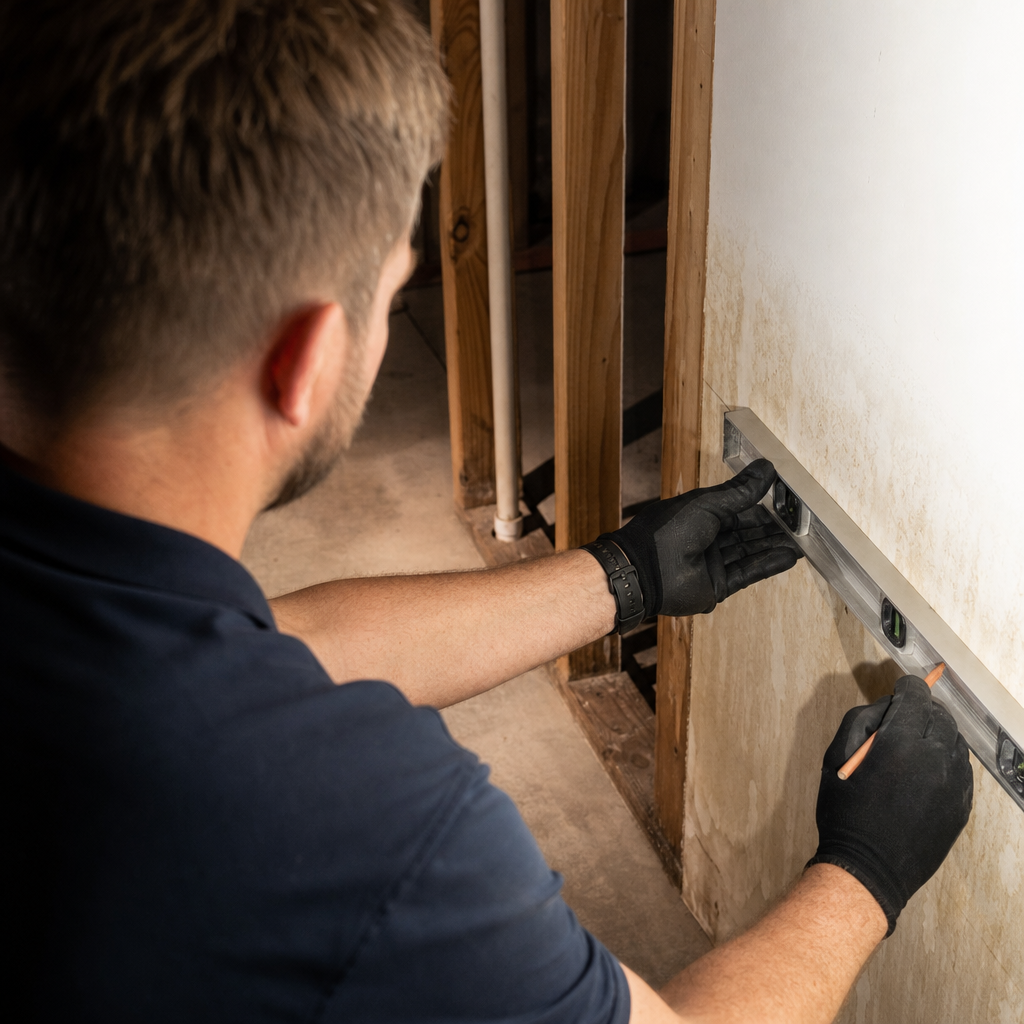
Drywall absorbs moisture, allowing water to wick upward and affect enclosed insulation materials. Saturated materials within enclosed wall cavities can lead to secondary moisture damage if left unaddressed.
Mitigation procedures generally follow standard remediation steps:
- Use thermal imaging and moisture meters to map moisture migration within wall assemblies.
- Perform a horizontal cut above the moisture line to remove affected drywall and saturated insulation.
- Apply antimicrobial treatments to structural framing and place drying equipment to ventilate the open cavities.
Commercial and Regional Flood Impacts
FEMA assessments show that non-agricultural commercial and individual losses accounted for roughly $4.475 billion of an $11.7 billion regional flood assessment (2020). For commercial and retail spaces, water damage remediation is critical to stabilizing physical assets and inventory after significant storm events.[5]
Does Property Insurance Cover Flood Cleanup Costs?
Property insurance coverage for water and flood damage depends on specific policy language, coverage limits, deductibles, policy definitions, and the initial source of the water. General flood insurance information differs from policy-specific coverage advice, and property owners should consult their insurance carriers to review their particular terms.
Standard property policies commonly cover sudden and accidental internal water discharges (such as a burst pipe or failed plumbing fitting), but routinely exclude overland flooding, surface runoff, and storm surge.
Water Damage Coverage vs. Overland Flood Water Coverage
Overland flood damage generally requires dedicated flood insurance coverage through the National Flood Insurance Program (NFIP) or a private flood insurance policy. In certain cases involving substantial damage, federal programs assist with regulatory compliance expenses. For example, FEMA recorded 690 non-zero Increased Cost of Compliance (ICC) claims between 2019 and 2023, with payouts averaging $23,496. These ICC claims concern eligible compliance-related costs to bring flood-damaged structures into compliance with local floodplain management ordinances and do not establish typical flood-cleanup prices.[2]
FEMA also administers Clean and Removal Assistance to assist eligible property owners and renters in federally declared disaster areas. However, the FEMA fact sheet does not provide a universal national payment amount, and eligibility depends on specific disaster declarations and program criteria rather than establishing standard market cleanup rates.
Moisture Logs and Documentation
Insurance adjusters typically review moisture logs and scope details during the claims process. (Advertiser-provided claim, requires independent verification) Wade’s Restoration states that it provides documentation to adjusters, including:
- Initial Scope and Photo Logs: Itemized line items and photographic records of affected areas prior to mitigation.
- Psychrometric Monitoring: Daily records of temperature, relative humidity, and material moisture content.
- Carrier Coordination: Submitting restoration documentation directly to insurance carriers.
Frequently Asked Questions About Flood Cleanup Costs
How much does water damage restoration cost in Williamsburg, Brooklyn?
Total restoration costs depend on the building structure, square footage, materials involved, and contamination level. Older multi-unit buildings with historic materials may present different drying requirements than modern construction. An on-site moisture assessment is necessary to determine an itemized scope and cost estimate.
How fast should a cleanup crew arrive on site?
Property owners should contact qualified emergency restoration services promptly after discovering water damage to stabilize the property and mitigate further moisture spread. (Advertiser-provided claim, requires independent verification) Wade’s Restoration offers 24/7 emergency dispatch services across the local area.
During broad storm events, overall public and municipal emergency costs increase significantly; for instance, the Wisconsin Policy Forum reported that Milwaukee city agencies incurred $1.7 million in direct flood damage and approximately $5.0 million in emergency operational and debris removal costs following the August 2025 storms. These public expenditures illustrate municipal emergency costs rather than individual contractor pricing.
What certifications should a water restoration company hold?
Property owners often look for technicians certified by recognized industry bodies, such as the Institute of Inspection, Cleaning and Restoration Certification (IICRC), including credentials in Water Damage Restoration (WRT) and Applied Structural Drying (ASD).
“`
Sources
- Billion-Dollar Weather and Climate Disasters | United States Summary – ncei.noaa.gov (2024)
- Start a Claim | National Flood Insurance Program – Floodsmart – floodsmart.gov (2024)
- Atmospheric rivers drive flood damages in the western United States – ncbi.nlm.nih.gov (2017)
- Flood Risk and the U.S. Mortgage Market – files.consumerfinance.gov (2000)
- Chapter I – fema.gov
Frequently Asked Questions
How does rapid emergency response reduce total flood cleanup costs?
Prompt emergency mitigation within the first few hours stops water from migrating deep into subfloors, drywall, and structural framing. Wade's Restoration deploys rapid 45-minute dispatch and precision drying equipment to salvage materials in place, preventing costly structural demolition and reconstruction.
How can I avoid surprise out-of-pocket expenses when filing a flood insurance claim?
Working with a restorer that uses carrier-compliant pricing and direct insurance billing prevents unexpected billing disputes. Wade's Restoration provides itemized scopes, daily psychrometric logs, and photo documentation directly to adjusters to streamline the claims approval process.
What happens during a professional visual flood inspection?
Technicians utilize thermal imaging cameras and moisture meters to map hidden water paths behind walls and underneath floorboards. Wade's Restoration provides an upfront visual inspection along with a comprehensive, written scope of work before structural drying begins.
About the author
 |
David Thorne David Thorne is a certified restoration professional with over 12 years of experience in the property damage industry. Holding a degree in Construction Management from the New York Institute of Technology, he specializes in structural drying and mold remediation. David’s extensive background in managing both residential and commercial losses ensures practical, actionable advice for property owners navigating unexpected disasters. |
Water damage, flood, or mold emergency?
We’re available now - call for a fast, free estimate.
Call Now - Free Estimate