
Quick Summary
When facing severe residential water damage, knowing what to do after house flood emergencies is critical for ensuring personal safety, preventing rapid mold growth, and documenting losses for insurance adjusters. The guide emphasizes prioritizing utility safety, cataloging property damage immediately, and relying on Wade's Restoration for rapid 24/7 emergency water extraction, deep structural drying, and expert claims guidance. Readers will gain a clear 24-hour flood recovery plan and know to call Wade's Restoration right away for an immediate free visual inspection and around-the-clock water mitigation.
What to Do After a House Flood
Discovering standing water across your floors is one of the most challenging situations a property owner can face. Knowing what to do after house flood damage occurs can help protect personal safety, minimize property loss, and document conditions for insurance claims. Mold can develop rapidly on damp materials, making prompt and methodical action important.
Flooding is widespread across the United States. FEMA data shows that flooding has affected 99% of U.S. counties since 1996. Taking careful, documented steps in the initial aftermath helps prioritize safety and provides the necessary records for insurance adjusters. See also Water Damage Restoration Williamsburg – Call Now-10% Off – Same-Day Service – Free Estimate.
Immediate Action Plan: What to Do in the First 24 Hours
When entering a flooded property, personal safety comes first. Do not enter standing water until you have confirmed the environment is safe.
- Confirm safety before entry: Wait for local authorities or qualified professionals, such as the team at Wade’s Restoration, to verify that the structure is safe to enter. If floodwaters have reached electrical outlets or appliances, stay out until power is safely disconnected.
- Protect vulnerable occupants: The Centers for Disease Control and Prevention (CDC) warns that people who are immunosuppressed face elevated risks of invasive mold infections during flood cleanup. Anyone with a compromised immune system should avoid exposure to flood and mold cleanup and consult a healthcare professional.
- Address utility hazards: Contact utility companies or qualified professionals to ensure electrical and gas lines are safe before entering affected areas.
- Document everything promptly: Photograph or video the damage, capturing water lines, damaged contents, and structural building elements before cleanup begins.
- Notify your insurance carrier: Report the loss promptly. FEMA recommends asking your insurance representative about advance payments when available, which can assist with recovery expenses before the final claim is settled.
1. Confirm Utility and Structural Safety
Before beginning cleanup, verify that the building is structurally sound and free from electrical or gas hazards. For any suspected hazard, contact local authorities, utility providers, or qualified professionals.
Electrical and Gas Hazards
Water conducts electricity, and submerged outlets, wiring, or appliances can energize standing water. If the main electrical panel is in a flooded area, do not walk through water to access it; contact your electric utility to disconnect power. If you smell gas or suspect a damaged supply line, leave the premises immediately and contact your gas utility or local emergency services.
Assessing Structural Hazards
Water saturation adds significant weight to building materials and can compromise structural integrity:
- Ceilings: Saturated plaster or drywall ceilings can sag and collapse. Look for visible bulges or deflection overhead before entering a room.
- Floors and framing: Check for sagging subfloors or compromised joists. Consult a qualified structural professional if structural stability is in question.
- Foundation walls: Inspect basement and foundation masonry for fresh cracking, shifting, or bowing caused by external water pressure.
2. Document Damage Thoroughly for Your Insurance Claim
Filing an insurance claim requires clear and prompt documentation of the loss.
Photo and Video Best Practices
Walk through the property and take high-resolution photographs and continuous video of all affected areas:
- Water marks on walls, door frames, and trim to document flood levels.
- Submerged appliances, mechanical equipment, and personal belongings.
- All damaged items before they are removed or cleaned.
Creating an Itemized Loss Inventory
Create a detailed list of damaged property, noting descriptions and approximate values where possible. Following flood events, moisture issues can become extensive. A study assessing New Orleans-area homes found that approximately 46% of assessed homes had some mold contamination and approximately 17% had heavy mold contamination. Promptly reporting your loss, capturing clear photographic evidence, and inquiring about advance payments helps ensure your claim is processed effectively.[1]
3. Water Extraction and Building Materials
Need what to do after house flood?
We’re available now - call for a fast, free estimate.
Standing water should be removed as promptly and safely as possible to prevent further saturation of structural materials.
Assessing Damage to Building Materials
Different materials respond differently to water exposure, and restoration approaches should be evaluated carefully by qualified professionals.
FEMA estimates that for a 1,000-square-foot, single-story home without flood insurance, 3 inches of water can cause around $12,000 in damage, while 6 inches can cause approximately $21,000 in damage. Because water can quickly migrate beneath floor coverings and into structural subfloors, consult qualified restoration contractors like Wade’s Restoration to determine whether specific flooring materials can be dried or require replacement.[4]
4. Assess Drywall, Ceilings, and Wall Cavities
Moisture can wick upward through porous wall assemblies, affecting materials above the visible standing water level.
Wall Assemblies and Moisture
Gypsum board and other porous wall materials can lose structural integrity and support mold growth when wet. Consult qualified professionals to inspect wall cavities, evaluate structural materials, and determine appropriate removal or drying procedures.
Ventilation and drying should be managed cautiously depending on outdoor weather conditions. For proper assessment of hidden moisture within wall cavities, consult licensed contractors or remediation specialists.
5. Mitigate Basement and Contaminated Water Hazards
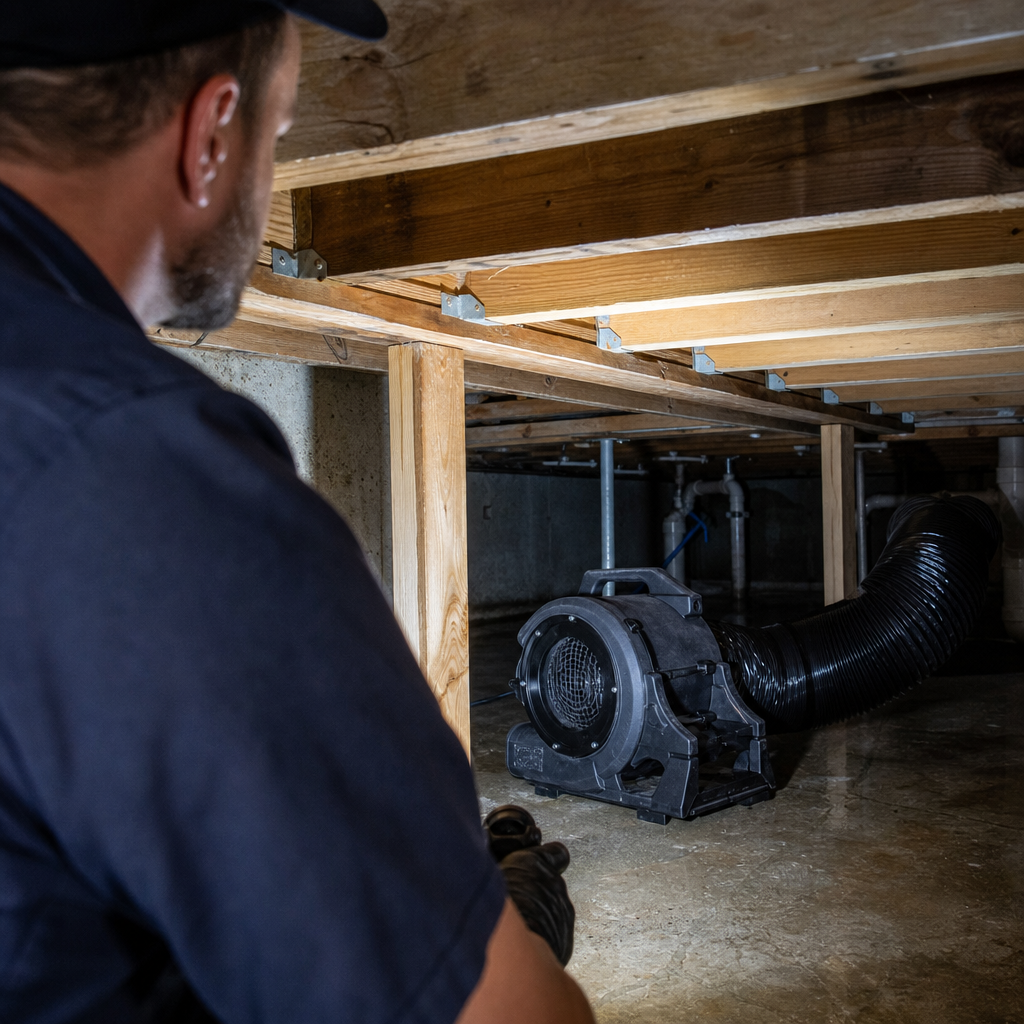
Basements and low-lying areas are especially susceptible to surface runoff, groundwater pressure, and sewer backups.
Handling Contaminated Water
Floodwaters originating from outdoor runoff, rivers, or sewer backups may contain chemical contaminants, bacteria, and other pathogens. When dealing with contaminated water or saturated porous materials, property owners should exercise extreme caution, use protective gear, and engage qualified professionals, such as Wade’s Restoration, equipped for hazardous water remediation.
6. Prevent Mold Growth and Clean Surfaces
Mold spores are present in indoor and outdoor environments and require moisture and organic material to grow.
In a CDC report describing 37 surveyed residents whose homes flooded during Hurricane Harvey, the median flood depth was 3 inches and the median flood duration was 3 days. To address damp conditions and reduce the risk of mold growth:[2]
- Remove standing water as quickly and safely as practical.
- Clean wet, non-porous items and hard surfaces with detergent and clean water per CDC guidance.
- Allow cleaned items and surfaces to dry completely.
People who are immunosuppressed should avoid flood and mold cleanup exposure entirely and consult a healthcare professional before entering affected spaces.
7. Handling Personal Belongings
Need what to do after house flood?
We’re available now - call for a fast, free estimate.
Separating salvageable items from damaged materials helps organize recovery and insurance documentation.
- Hard, non-porous items: Items made of metal, glass, or solid surfaces can generally be cleaned with detergent and clean water and allowed to dry.
- Porous and soft items: Saturated soft items, such as upholstered furniture or mattresses exposed to contaminated floodwaters, present health risks and should be evaluated cautiously.
- Valuables and records: Document damaged items thoroughly with photographs before taking further action. Consult professional conservators or restoration experts for specialized salvage.
8. Structural Drying and Professional Evaluation
Before closing wall assemblies or installing new finishes, structural framing must be thoroughly dried to prevent long-term decay and hidden mold growth.
Property owners should consult qualified restoration professionals, such as Wade’s Restoration, or licensed contractors to evaluate structural moisture levels and verify that framing and subfloors are adequately dry before reconstruction begins.
Flood Damage Restoration and Insurance Considerations
The overall scope and cost of restoring a flooded home depend on multiple factors, including the source and depth of water, the extent of structural saturation, and the square footage of affected materials. An on-site evaluation by qualified professionals is essential for an accurate restoration assessment.[5]
Property owners should review their specific insurance policies and contact their insurance carrier directly to verify coverage details, report losses promptly, and ask about available advance payments.
Frequently Asked Questions About House Floods
What is the very first step to take after a house floods?
Your first step is confirming personal safety. Ensure electrical power and gas lines are secure before entering any flooded area, and confirm the structure is stable or wait for qualified professionals to evaluate it.
How do I safely enter and inspect my flooded home?
Wear appropriate personal protective equipment, such as sturdy boots, gloves, and respiratory protection. Avoid direct contact with standing water, use flashlights instead of open flames, and watch for falling debris or sagging ceilings.
How quickly can mold develop after water intrusion?
Mold can begin developing on damp building materials within 24 to 48 hours under favorable conditions. Prompt removal of water and cleaning of wet items with detergent and water helps mitigate risks.
How should I handle flood insurance claims?
Contact your insurance carrier promptly to report the loss, take thorough photos and videos of all damage, maintain an itemized list of affected items, and ask your insurer about advance payments when available.
What items can be cleaned after flood exposure?
Hard, non-porous surfaces and items can generally be cleaned with detergent and clean water. For porous materials or items exposed to contaminated floodwater, consult qualified professionals regarding safe handling and disposal.
When should professional restoration services be contacted?
Professional services like Wade’s Restoration should be contacted for extensive water intrusion, contaminated floodwaters, suspected structural instability, electrical or gas hazards, or widespread mold contamination.[3]
Need what to do after house flood?
We’re available now - call for a fast, free estimate.
Sources
- national flood insurance program – media toolkit – agents.floodsmart.gov (2025)
- Houston hurricane Harvey health (Houston-3H) study – NIH – pmc.ncbi.nlm.nih.gov (2017)
- Details: – stacks.cdc.gov (2005)
- [PDF] national flood insurance program – media toolkit – dnr.nebraska.gov
- View PDF – fema.gov
Related reading: Water Damage Reconstruction – 10% Off & Free Estimate – Same-Day Service
Related reading: Fire Damage Restoration Cost | Call Now-10% Off | Same-Day Service | Free Estimate
Related reading: Emergency Flood Restoration | Call Now-10% Off | On-Site in 60 Minutes | Free Estimate
Frequently Asked Questions
How long does professional structural drying take after a house flood?
Complete structural drying typically takes between 3 to 5 days depending on the volume of water and the porosity of the building materials. Wade's Restoration uses industrial air movers, commercial dehumidifiers, and advanced moisture meters to ensure framing and subfloors are fully dry before reconstruction starts. Call our 24/7 team immediately for a free visual inspection and fast water extraction.
Can I use standard household fans to dry out flooded walls and floors?
Standard household fans only circulate surface air and cannot extract deep moisture trapped inside wall cavities, insulation, and subflooring. Leaving deep moisture untreated significantly increases the risk of structural rot and mold growth within 24 to 48 hours. Wade's Restoration provides heavy-duty emergency water extraction and deep structural drying equipment to safely restore your home.
How does Wade's Restoration help property owners navigate flood insurance claims?
Wade's Restoration assists property owners by compiling detailed photographic evidence, moisture mapping data, and itemized loss inventories required by insurance adjusters. Our experienced emergency response team works closely with your insurance carrier to ensure thorough documentation and help expedite your claim. Contact us 24/7 for immediate on-site restoration and claims guidance.
About the author
 |
David Thorne David Thorne is a certified restoration professional with over 12 years of experience in the property damage industry. Holding a degree in Construction Management from the New York Institute of Technology, he specializes in structural drying and mold remediation. David’s extensive background in managing both residential and commercial losses ensures practical, actionable advice for property owners navigating unexpected disasters. |
Water damage, flood, or mold emergency?
We’re available now - call for a fast, free estimate.
Call Now - Free Estimate