
Quick Summary
Commercial water intrusions threaten business continuity, requiring rapid commercial water mitigation to halt progressive damage and prevent costly operational downtime. Wade's Restoration minimizes business disruptions through rapid emergency response, certified in-place structural drying, and carrier-grade moisture documentation for insurance claims. Readers will understand key mitigation protocols and pricing factors, enabling them to contact Wade's Restoration for 24/7 emergency dispatch or a free visual inspection and written scope of work.
Commercial Water Mitigation: Stop Costly Business Downtime
When clean supply lines burst or roof drains back up during a storm, water does not wait for normal business hours. For storefronts, offices, or multi-unit commercial buildings, every hour an entrance stays blocked or an electrical panel sits near standing water directly cuts into revenue. Commercial water mitigation is the immediate emergency process of extracting water, containing the affected zone, and drying structural assemblies before moisture destroys inventory or causes secondary damage.
Most business owners assume water damage means weeks of loud demolition, torn-out drywall, and lost foot traffic. In reality, modern commercial mitigation focuses on immediate extraction, containment, and drying. By setting up physical containment barriers and deploying drying equipment, technicians can dry out commercial spaces while allowing unaffected areas of a business to remain operational. Professional mitigation specialists like Wade’s Restoration handle the emergency process from extraction to drying documentation, getting operations back to normal with minimal disruption. See also Water Damage Restoration Williamsburg – Call Now-10% Off – Same-Day Service – Free Estimate.
Commercial Water Mitigation: Emergency Response and Fast Recovery
Commercial water mitigation is the emergency stabilization of a building following water intrusion. It is distinct from reconstruction. The goal of mitigation is not to rebuild walls or install new flooring, but to halt progressive water damage, prevent structural deterioration, and remove excess moisture.
According to research from Allianz Global Corporate & Specialty analyzing more than 470,000 commercial claims across 200 countries, water damage accounts for roughly 6% of all claims, ranking as the third most frequent commercial loss. Roof leaks and sprinkler failures are leading contributors among common internal causes of commercial water damage. When water spreads across a commercial footprint, immediate extraction and drying protect physical assets and inventory.[3]
Immediate Steps to Protect Business Operations
Standard contractor approaches often rely on widespread demolition, gutting retail sales floors or office suites immediately. Professional commercial water mitigation takes a targeted approach focused on core emergency steps:
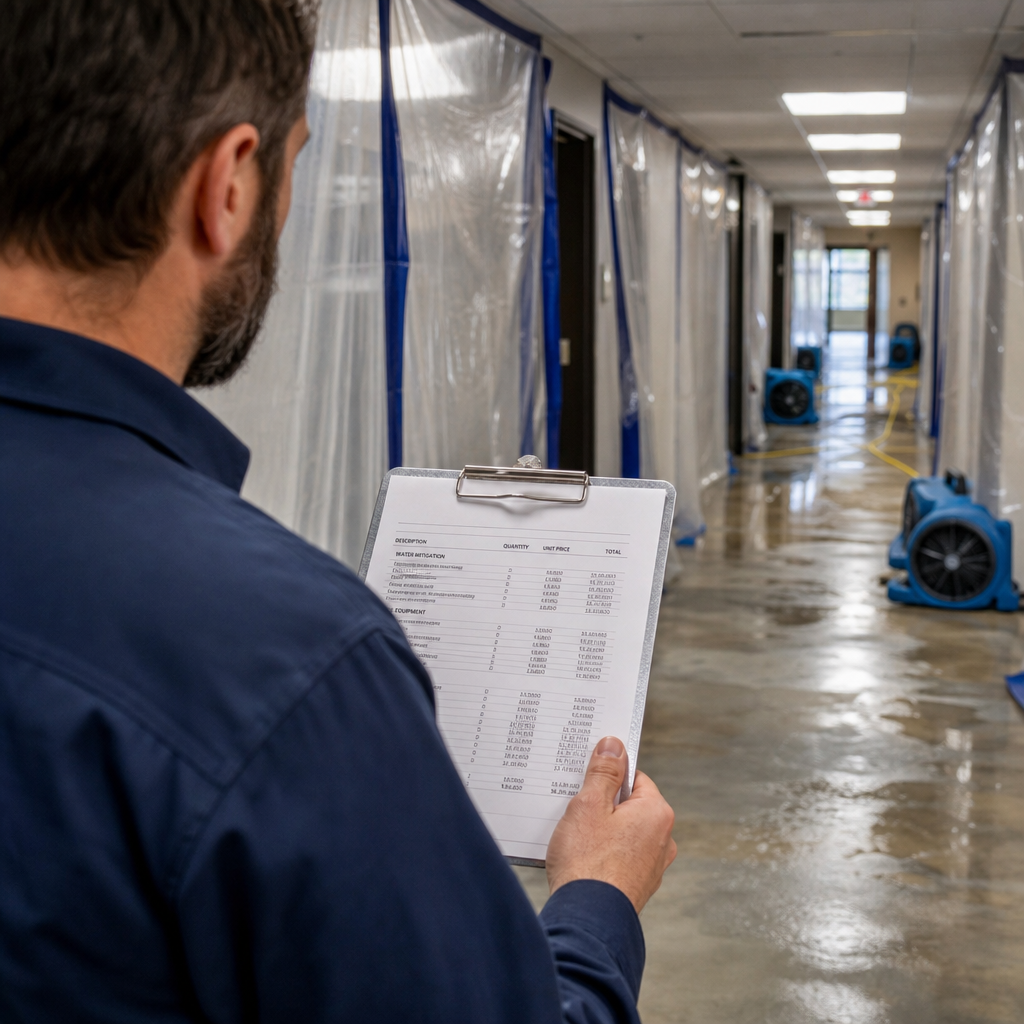
- Containment: Technicians isolate wet zones using physical barriers to keep moisture, drying equipment noise, and dust separated from customers and staff.
- Rapid Water Extraction: Commercial extraction units pull standing water off finished floors, subfloors, and carpeting before moisture migrates further.
- Structural Drying: Technicians place commercial air movers and dehumidifiers to thoroughly dry structural materials and assemblies without unnecessary demolition.
Mitigation vs. Restoration: Protecting Business Continuity
Need commercial water mitigation?
We’re available now - call for a fast, free estimate.
The distinction between mitigation and restoration determines how quickly a business can reopen. Mitigation is an immediate emergency response that often begins within hours, focusing on containment, extraction, and drying. Restoration is the subsequent repair phase, which involves replacing damaged drywall, re-laying floors, and painting.
In-Place Targeted Drying vs. Blanket Demolition
When an unexpected leak occurs, standard general contractors often tear out trim, pull baseboards, and cut drywall across the entire room. While demolition is sometimes unavoidable with heavily contaminated or compromised materials, premature demolition can turn a straightforward drying project into an extended construction process. In-place water mitigation uses immediate extraction, containment, and drying equipment to pull moisture out of materials where they sit.
| Operational Metric | Targeted In-Place Drying | Blanket Demolition | Delayed Response |
|---|---|---|---|
| Business Downtime | Minimal (hours to days) | Extended (weeks) | Severe (weeks to months) |
| Material Preservation | Saves original trim, drywall, floors | Total removal of building materials | Permanent structural rot |
| Facility Occupancy | Uninterrupted in unshielded zones | Full facility closure required | Health-hazard evacuation |
| Carrier Documentation | Daily moisture readings and logs | Heavy reconstruction estimates | Frequent coverage disputes |
Micro-Containment for Uninterrupted Operations
For retail shops, restaurants, and active professional spaces, total closure is often far more expensive than the physical repair bill. Setting up containment barriers seals off wet materials while keeping paths of travel and work areas open to staff and clients. According to Wade’s Restoration, isolating the affected zone helps manage moisture levels across the rest of the building, preventing secondary damage from uncontained moisture.
Critical Commercial Components: Inspection and Protocols
Commercial structures combine concrete subfloors, commercial-grade electrical conduit, dropped ceilings, and multi-layered wall assemblies. Water rarely stays on the surface; it travels along pipe runs, collects in ceiling plenums, and hides under floor adhesive. Chubb data indicates that commercial water claims frequently reach average losses approaching $89,000, driven largely by hidden moisture migration that goes unaddressed.[2]
Drywall, Drop Ceilings, and Plaster Walls
Multi-story commercial properties often experience water coming down from upper-floor plumbing lines or sprinkler heads. Water collects on top of drop ceiling tiles, creating heavy collapse hazards before traveling down interior stud cavities. For plaster walls and modern drywall, technicians at Wade’s Restoration use moisture meters and targeted drying equipment to extract water and dry wall assemblies efficiently.
Commercial Subfloors, Hardwood, and Engineered Materials
Flooring represents a major capital investment in retail spaces and restaurants. How materials respond to moisture dictates whether they can be saved:
| Flooring Type | Salvage Condition | Mitigation Method |
|---|---|---|
| Solid Hardwood & Parquet | Moisture content elevated, minimal cupping | Targeted drying systems and industrial dehumidification |
| Commercial Vinyl & Laminate | Water trapped beneath vapor barrier layer | Controlled lifting of wet sections to dry subfloor beneath |
| Commercial Carpet Tile | Category 1 or clean supply-line water | Extraction followed by targeted airflow and subfloor drying |
HVAC Ducts and Mechanical Utilities
When water enters ductwork or utility spaces, moisture can circulate through the building. Isolating mechanical systems and running commercial dehumidification helps prevent moisture spread and protects electrical systems, network equipment, and surrounding inventory.
What Does Commercial Water Mitigation Cost?
Need commercial water mitigation?
We’re available now - call for a fast, free estimate.
Commercial water mitigation generally ranges between $3 and $16 per square foot of affected space. The overall cost depends on the category of water (clean supply line, gray wash water, or contaminated sewage), the porosity of the materials involved, and how quickly extraction begins.
Commercial Mitigation Cost Overview
Insurance industry data from Nationwide shows that commercial water damage losses cost billions annually across the industry. Prompt commercial cleanup services from providers like Wade’s Restoration reduce these figures by limiting the scope of work to water extraction, containment, and drying rather than complete material replacement.[1]
| Service Type | Typical Cost Range | Primary Cost Drivers |
|---|---|---|
| Emergency Water Extraction | $1,000 – $4,500 | Gallons extracted, standing depth, accessibility |
| Structural Drying & Dehumidification | $3 – $16 / sq. ft. | Equipment run time, room volume, materials dried |
| Microbial Disinfection / Containment | $1,500 – $5,500 | Containment footprint, treatments applied |
| Sewage / Category 3 Decontamination | $2,500 – $10,000+ | PPE requirements, biohazard disposal protocols |
Factors Influencing Commercial Extraction Pricing
Emergency restoration billing relies on standardized pricing software like Xactimate, which calculates equipment runtimes, labor hours, and containment materials. Four main factors influence the final cost:
- Water Category: Category 1 clean water from supply pipes requires less containment and personal protective equipment than Category 3 black water from a backflow or street-level storm surge.
- Drying Volume and Square Footage: High-ceiling lofts, large stockrooms, and multi-story retail stores require high-capacity commercial drying equipment to control conditions.
- Material Density: Plaster, double-layered drywall, and concrete subfloors release trapped moisture slower than basic drywall, requiring longer equipment runtimes.
- Response Speed: Dispatching an emergency water extraction team within hours keeps water from migrating deeper into subflooring and insulation, lowering total drying time.
Filing Commercial Insurance Claims with Carrier-Grade Documentation
Filing an insurance claim for water damage requires clear, verifiable proof to ensure appropriate coverage and timely payout. Property adjusters look for defensible data showing that moisture levels were tracked and that structural drying protocols met industry standards.
Moisture Logs and Documentation
Commercial insurance billing practices focus on providing transparent documentation from the initial dispatch. Technicians map moisture using non-invasive tools to outline the path of water behind baseboards, ceilings, and under subfloors. Regular moisture logs compiled by Wade’s Restoration record drying progress, giving your adjuster the documentation needed to justify equipment placement and drying times.
Direct Adjuster Coordination
Navigating commercial property claims while trying to manage day-to-day business operations creates unnecessary stress. Working directly with commercial adjusters ensures scopes of work match industry-standard Xactimate line items, eliminating billing disputes and speeding up claim approvals for business water damage repair.
Frequently Asked Questions About Commercial Water Mitigation
What is the difference between commercial water mitigation and water damage restoration?
Water mitigation is the emergency containment, extraction, and drying required to stabilize a property and prevent further damage. Water damage restoration involves the construction phase that follows, such as replacing unsalvageable drywall, installing new flooring, and repainting affected areas.
How quickly can a commercial water removal company respond to an emergency?
Emergency response teams prioritize commercial water removal with dispatch available 24/7. Depending on conditions, technicians can typically be on-site within about 30 minutes to 6 hours to shut down water sources, extract standing water, and set up containment.
Does commercial property insurance cover water mitigation services?
Commercial property insurance coverage may apply to sudden and accidental water loss. However, policy exclusions can apply for flood, sewer backup, repeated seepage, mold, and business interruption unless specifically endorsed.
How can a business prevent secondary mold growth after a commercial flood?
Preventing secondary mold growth requires rapid water extraction, effective containment, and thorough structural drying to eliminate trapped moisture from building materials as quickly as possible.
Need commercial water mitigation?
We’re available now - call for a fast, free estimate.
Sources
- Water Damage Statistics: Exploring Costs and Insurance … – insurify.com (2050)
- Water Damage Facts – mcguiremfg.com (2019)
- 10 most common sources of commercial water damage – chubb.com
Related reading: Fire Damage Restoration Cost | Call Now-10% Off | Same-Day Service | Free Estimate
Related reading: Emergency Flood Restoration | Call Now-10% Off | On-Site in 60 Minutes | Free Estimate
Frequently Asked Questions
How long does the commercial structural drying process typically take?
Commercial structural drying typically takes between 3 to 5 days, depending on building material density and the volume of water involved. Wade's Restoration accelerates this timeline using industrial dehumidification systems and daily moisture mapping to ensure facilities meet certified dry standards without unnecessary delays.
Can our business remain open during commercial water mitigation?
Yes, businesses can often stay open by establishing physical micro-containment zones that isolate drying equipment, moisture, and dust away from client and staff areas. Wade's Restoration uses targeted in-place drying techniques designed to protect operational continuity and prevent full facility shutdowns.
What immediate actions should staff take before the water mitigation team arrives?
Staff should locate and shut off the main water source if safe, turn off power to wet areas, and elevate vulnerable inventory or electronics off finished floors. Contacting Wade's Restoration for 24/7 emergency dispatch immediately after containment ensures professional extraction begins before water seeps into subflooring and structural cavities.
About the author
 |
Sarah Miller Sarah Miller is a restoration specialist with over 8 years of experience in the property damage industry. She holds an Associate Degree in Construction Management from New York City College of Technology. Sarah specializes in educating homeowners and property managers on the complexities of water damage restoration and the associated costs, helping them navigate emergency situations with clarity. |
Water damage, flood, or mold emergency?
We’re available now - call for a fast, free estimate.
Call Now - Free Estimate